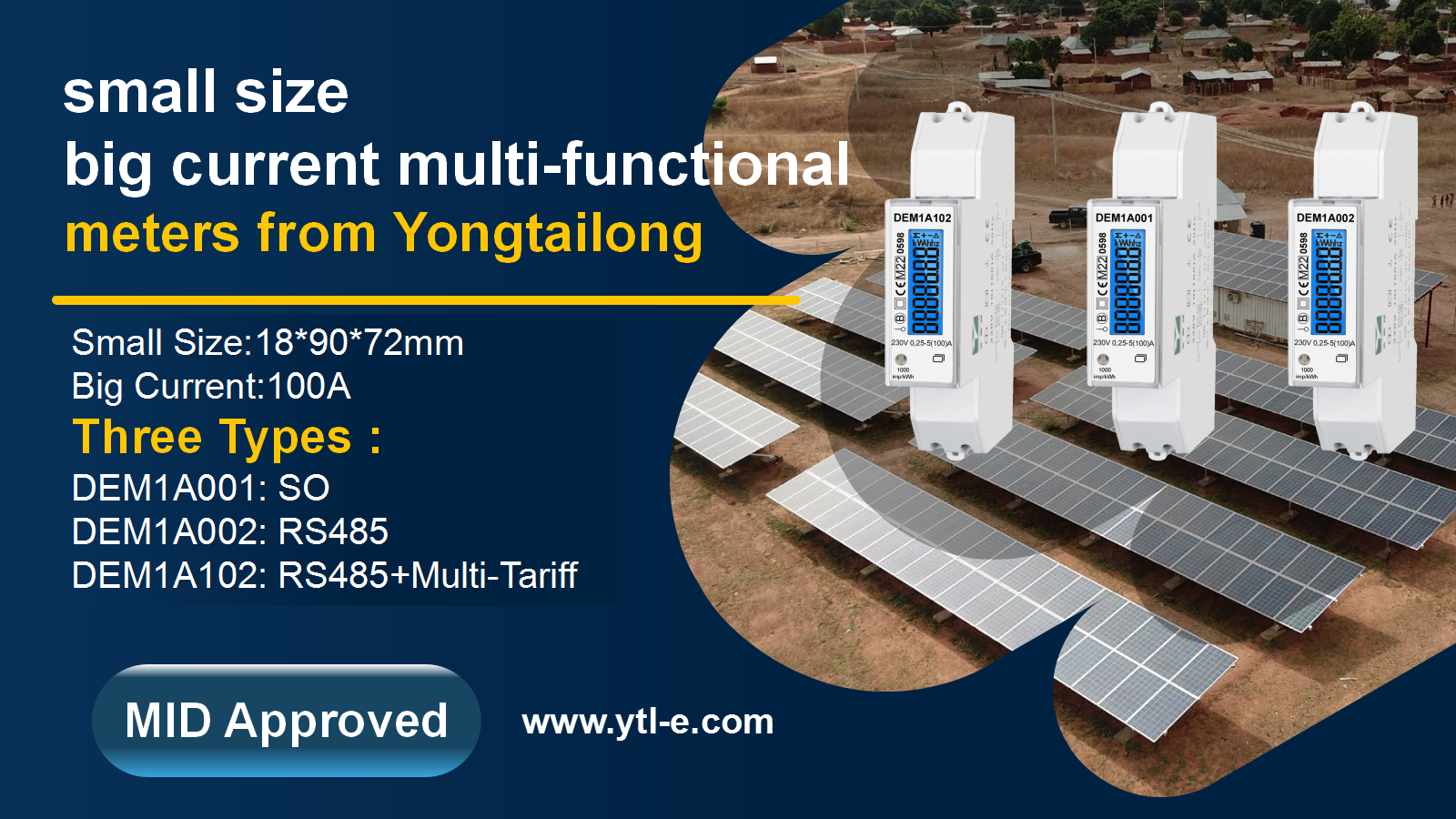
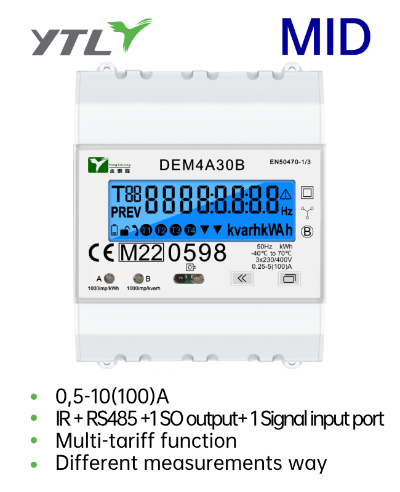
 The energy meter is an instrument used to measure electrical energy. An 100A Energy Meter, which refers to a meter that can measure a maximum current of 100A,if the load current exceeds 100A, it will cause damage to the energy meter. Simply speaking about the parameter of 100A alone is difficult to have a clear understanding. For a 230V single-phase energy meter with 100A, the maximum allowable power is 230V×100A=23000W=23kW, and it will consume 23 kWh at full load for one hour.
It can support the simultaneous use of 7 air conditioners and 9 electric kettles in a household. For a typical family, a 100A energy meter is sufficient, and most households use a energy meter with a maximum current of 60A.
The current parameter of the 100A energy meter , must be paired with a rated current parameter according to the standard, commonly 5(100)A, 10(100)A, 20(100)A. The 5, 10, and 20 in these are the rated currents, and the size of this rated current determines the sensitivity and the minimum accurately measurable current size of the electric energy meter. The smaller the rated current value, the higher the sensitivity and the smaller the accurately measurable current, but the design technical difficulty is also greater.
Some people may ask whether it is possible to measure the smallest current of 0.4A and the largest current of 90A on this side? Which specification meter should be selected? Taking the most commonly used 1 and meter as an example, there are clear instructions in the energy meter measurement accuracy standard. The energy meter can initiate measurement when the current is greater than 0.4% of the rated current, and can accurately measure when the current is greater than 5% of the rated current. The 5(100)A current specification energy meter can initiate measurement at 20ma (5×0.4%=20ma), and must be able to accurately measure at 0.25A (5×5%=0.25A).
Therefore, the minimum current is 0.4A can be accurately measured by selecting a rated current of 5 and a maximum current of 100A for the energy meter.
 Under the same rated current, how should we choose between 40A, 60A, 80A, and 100A energy meter? In theory, using a 100A energy meter can accommodate 40A, 60A, and 80A energy meters, however in terms of cost, the material cost increases with higher current specifications, and consequently, the selling price increases as well. When selecting energy meter, choose the one with the appropriate current specification according to the size of your maximum load.
The 100A energy meter is mainly used for residential, industrial, commercial buildings, and schools, etc. Different users have different application scenarios and demands, requiring energy meters with different specifications and functions for matching use. When selecting the 100A energy meter, attention should be paid not only to the rated current, but also to the power supply method, voltage size, and other functions. There are single-phase two-wire 100A Energy Meter, single-phase three-wire 100A Energy Meter, two-phase three-wire 100A Energy Meter, three-phase three-wire 100A Energy Meter, and three-phase four-wire 100A Energy Meter. Common voltages include 220V, 230V, 110V, etc.
With the development of electronic technology and increasing market demand, the functions of the 100A electric meter are also increasing, these include load curve, event recording, event alarms, remote communication, firmware upgrades, anti-theft electricity, prepaid electricity, and load control. In the future, the electric meter may integrate more functions and smart sensors, realizing applications such as remote meter reading, electricity use monitoring, and energy efficiency management. The electric meter is also constantly being upgraded and replaced.
Understanding the meaning of the “100A” energy meter requires in-depth exploration of multiple aspects, including current units and conversion, the working principle of the energy meter, the meaning of energy meter parameters, the selection of the appropriate energy meter, safety precautions, and future development trends and challenges. Only in this way can we better understand the working principle and application scenarios of the energy meter, and provide strong support for practical applications.