









Introduction: Why Harmonic Monitoring Matters in Solar and Battery Storage Projects
Solar photovoltaic (PV) systems and battery energy storage systems (BESS) increasingly rely on power electronic equipment to convert and manage electrical energy.
PV inverters and BESS power conversion systems (PCS) perform essential energy conversion functions. However, these systems also operate within electrical networks that may contain nonlinear loads, switching equipment and other potential sources of harmonic distortion.
For commercial and industrial projects, monitoring total energy consumption alone may not provide enough information about electrical operating conditions.
Project engineers may also need to understand voltage distortion, current harmonics, power factor, phase imbalance and other electrical parameters at defined measurement points.
This creates an important engineering question:
Where should harmonic measurements be taken in a PV+BESS project, and what type of power meter should be selected?
A multifunction panel power meter can provide useful harmonic information for operational monitoring. However, the appropriate measurement boundary, current-sensing method, harmonic functions and verification requirements must be established before selecting a device.
1. What Is Harmonic Monitoring?
Harmonic monitoring is the measurement of voltage or current waveform components at integer multiples of the fundamental electrical frequency.
In a 50 Hz electrical system, for example:
- 1st harmonic: 50 Hz fundamental frequency
- 3rd harmonic: 150 Hz
- 5th harmonic: 250 Hz
- 7th harmonic: 350 Hz
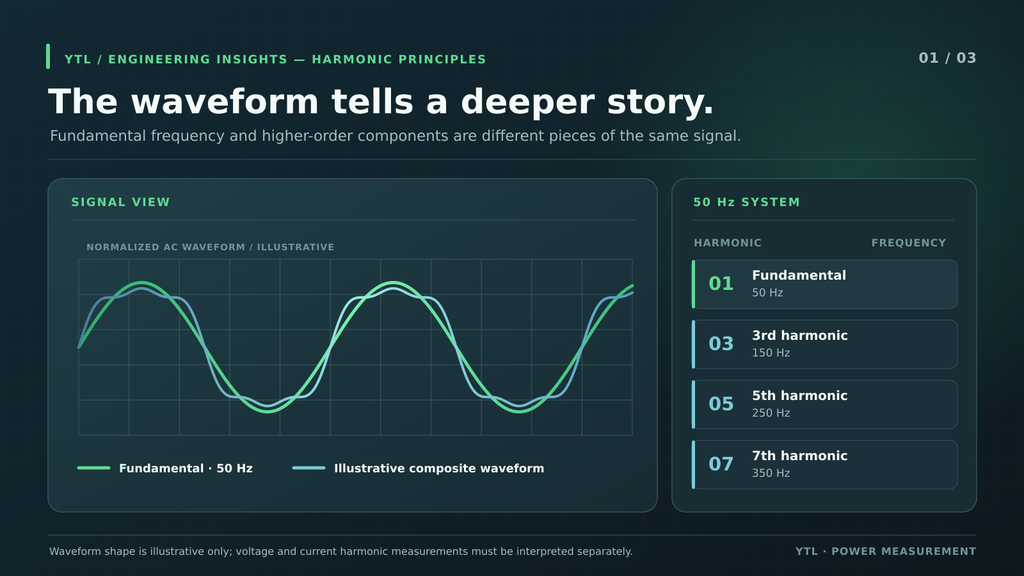
Harmonics can arise from different types of nonlinear electrical equipment, including power electronic converters, variable-frequency drives and other connected loads.
A useful distinction is between voltage harmonics and current harmonics.
Voltage harmonics describe distortion in the voltage waveform at a measurement point.
Current harmonics describe harmonic components in the current flowing through a measured circuit.
These quantities are related, but they are not interchangeable.
Another commonly used parameter is total harmonic distortion (THD), which expresses the combined contribution of measured harmonic components relative to the fundamental component under a defined calculation method.
THD does not identify every individual harmonic, and a THD value alone does not establish the cause of distortion.
For PV and BESS projects, engineers may need both individual harmonic information and wider operating data to understand electrical conditions.
2. Where Should Harmonics Be Measured in a PV+BESS Project?

Harmonic measurement location is one of the most important engineering decisions.
A solar-plus-storage installation can contain several relevant AC measurement boundaries.
2.1 PV Inverter AC Output
A meter located at the PV inverter AC output can provide electrical measurements associated with the inverter connection.
Depending on the instrument, this may include:
- Voltage and current
- Active and reactive power
- Power factor
- Energy
- Voltage harmonics
- Current harmonics
This location can help engineers observe electrical conditions near a PV inverter.
However, measurements at the inverter output do not automatically represent harmonic conditions at the wider site’s point of common coupling.
2.2 BESS PCS AC Boundary
The PCS converts electrical energy between the battery-side DC system and the AC electrical network.
A meter installed at the PCS AC boundary can support monitoring of:
- Charging and discharging power
- Import and export energy
- AC voltage and current
- Power factor
- Harmonic conditions at the selected AC measurement point
The project should distinguish PCS AC measurements from battery DC measurements.
AC harmonic monitoring and DC battery energy measurement serve different purposes and should not be treated as interchangeable functions.
PCS operating data and battery management system (BMS) information may provide additional context, but they do not automatically replace measurements from an independent electrical meter.
2.3 Main Distribution Panel
Commercial and industrial PV+BESS projects may connect several electrical assets to a shared distribution system.
A multifunction panel power meter can help monitor the combined electrical conditions at a selected distribution board or feeder.
This may be useful when a facility includes PV generation, BESS, industrial equipment, HVAC systems and other nonlinear loads.
Measurements at a shared distribution panel describe the electrical conditions at that boundary. They do not necessarily identify which individual device caused a particular harmonic component.
2.4 Point of Common Coupling (PCC)
The PCC is an important boundary when evaluating the interaction between a customer installation and the electrical network.
Harmonic conditions measured at the PCC may differ from those measured directly at an inverter or PCS terminal because of network impedance, connected equipment and other operating conditions.
Where a project requires formal harmonic assessment, engineers must identify the applicable measurement point, standard, instrument performance requirements and test methodology.
For a broader explanation of metering boundaries in renewable energy projects, see YTL’s Solar PV & ESS Metering application guide.
3. What Can a Multifunction Panel Power Meter Measure?
A multifunction panel power meter may combine energy measurement with several electrical monitoring functions.
Depending on the selected model, these can include:
- Three-phase voltage and current
- Active and reactive power
- Active and reactive energy
- Power factor
- Frequency
- Phase imbalance
- Individual voltage harmonics
- Individual current harmonics
- Event alarms
- Communication data output
These functions help provide a more detailed view of electrical operating conditions than cumulative kWh alone.
However, different parameters have different accuracy specifications and measurement methods.
For example, an active-energy accuracy class does not automatically describe harmonic measurement accuracy.
Likewise, a meter supporting individual harmonic analysis does not necessarily provide high-speed waveform capture, transient recording or all parameters required for formal power-quality compliance testing.
A multifunction panel meter should therefore be selected according to its documented functions rather than assuming that all power-quality features are included.
4. CT vs Rogowski Coil: Which Current-Sensing Method Should Be Used?
Current-sensing arrangement is an important consideration when selecting a panel power meter.
Conventional CT Input
Current transformer (CT) measurement is common in industrial distribution systems.
A CT-operated panel meter receives a standardised secondary-current input from compatible external CTs.
This configuration may suit projects where an existing CT infrastructure is available or where the electrical design specifies conventional CT measurement.
Selection should consider:
- CT ratio
- Primary current range
- Secondary-current rating
- Accuracy requirements
- Burden and wiring arrangement
- Phase mapping
- Installation and safety requirements
Rogowski Coil Input
Rogowski coils provide another method for measuring alternating current.
They may offer installation advantages in selected distribution cabinets, including situations where flexible sensors are useful around existing conductors.
However, Rogowski coils require a compatible measurement system and must be evaluated for the intended current range and measurement performance.
A Rogowski coil should not be treated as a universal replacement for a conventional CT.
For harmonic monitoring, engineers should also confirm the frequency-response characteristics and measurement performance of the complete meter-and-sensor arrangement.

5. YTL96-323D vs M30333: Choosing a Panel Power Meter for Harmonic Monitoring
The correct choice depends on the application, electrical current range, installation conditions and required measurement functions—not simply whether CT or Rogowski technology is newer.
Zhejiang Yongtailong Electronic Co., Ltd. (YTL) offers multifunction panel power meters for selected industrial distribution, solar PV, BESS and electrical monitoring applications.
Two relevant product options are the YTL96-323D and M30333.
YTL96-323D: CT-Operated Multifunction Panel Meter
The YTL96-323D is a 96 × 96 mm three-phase multifunction digital power meter.
Its documented features include:
- Conventional CT input rated at 5(6) A
- Class 0.5S active energy accuracy
- 2nd–63rd voltage harmonic analysis
- 2nd–63rd current harmonic analysis
- Three-phase electrical parameter measurement
- RS485 communication supporting Modbus RTU and DL/T 645-2007
- Y-Bus communication for supported external sensors
- Four digital inputs and two digital outputs
- Event alarms and sequence-of-events (SOE) recording
The YTL96-323D can be evaluated for electrical distribution panels where CT-operated measurement, energy accuracy and detailed electrical monitoring are required.
For solar PV and BESS applications, the product may support monitoring at selected inverter AC, PCS AC or distribution-panel measurement points.
The suitability of its harmonic functions must be verified against the project’s monitoring and reporting requirements.
M30333: Rogowski Coil Multifunction Panel Meter
The M30333 is a 96 × 96 mm three-phase multifunction panel power meter using external Rogowski coils.
Its documented features include:
- External Rogowski coil current measurement
- Published configuration with 20 A basic current and 600 A maximum current
- Class 1 active energy accuracy
- 2nd–63rd voltage harmonic analysis
- 2nd–63rd current harmonic analysis
- RS485 and Y-Bus communication
- Multifunction electrical monitoring
- Digital input and output functions
- Event alarms and SOE recording
The M30333 may be considered for installations where compatible Rogowski coil sensing is preferred.
Its application should be evaluated according to conductor arrangement, current range, sensor configuration and required monitoring functions.
Comparison of the Two Models
| Selection item | YTL96-323D | M30333 |
|---|---|---|
| Installation | 96 × 96 mm panel mount | 96 × 96 mm panel mount |
| Current input | Conventional CT, 5(6) A secondary | External Rogowski coil |
| Published active energy accuracy | Class 0.5S | Class 1 |
| Harmonic analysis | 2nd–63rd voltage and current harmonics | 2nd–63rd voltage and current harmonics |
| Communication | RS485 + Y-Bus | RS485 + Y-Bus |
| Typical selection consideration | Existing CT architecture and active-energy accuracy requirements | Rogowski sensor configuration and installation requirements |
Both models provide harmonic-monitoring functions, but their current-sensing arrangements and active-energy accuracy classes differ.
Neither should be described as universally superior.
The correct model depends on the project’s electrical architecture and technical requirements.
For other panel-mounted products, visit YTL’s Panel Power Meters category.
6. Harmonic Monitoring vs Formal Power-Quality Compliance Testing
An important distinction must be made between operational harmonic monitoring and formal power-quality compliance assessment.
Operational monitoring focuses on observing electrical conditions during normal plant operation.
A multifunction panel meter may support this by providing selected harmonic and electrical parameter measurements.
Formal compliance assessment may require additional conditions, including:
- An applicable technical standard
- A defined measurement boundary
- Specified measurement methods
- Instrument performance requirements
- Approved observation and aggregation periods
- Appropriate treatment of operating conditions
- Validated records and test procedures
For example, IEEE 519-2022 addresses harmonic control at the PCC under defined conditions.
IEC 61000-4-7 covers harmonic and interharmonic measurement instrumentation, while IEC 61000-4-30 defines methods for measuring power-quality parameters.
These references should not be interpreted as automatic certification claims for a particular meter.
A project requiring formal compliance evidence must confirm whether its selected measurement equipment and test procedures satisfy the applicable requirements.
A meter capable of measuring harmonics is not automatically a certified power-quality analyser or a substitute for specialised disturbance-recording equipment.
7. Communication, Data Collection and Measurement Verification
For projects integrating harmonic information into a gateway, EMS or monitoring platform, communication support is only one part of the evaluation.
Engineers should verify:
- Which harmonic parameters are available
- Whether individual harmonic values or THD values are required
- Register addresses and data types
- Measurement units and scaling
- Communication protocol and polling requirements
- Meter measurement-update behaviour
- Timestamp and interval requirements
- Missing or invalid data handling
- Alarm and event functions
A meter supporting Modbus RTU does not necessarily make every displayed electrical parameter available through the same register structure.
Harmonic register availability should therefore be confirmed using the exact model and firmware documentation.
Commissioning Checks
During installation and commissioning, the project team should verify:
- Correct voltage and current wiring
- CT ratio or Rogowski sensor configuration
- Sensor polarity and phase assignment
- Meter configuration and electrical system type
- Consistency between displayed and communicated values
- Harmonic parameter availability
- Monitoring platform interpretation
- Comparison with an appropriate reference instrument when required
For projects with multiple measurement points, data should also be aligned by location and time before comparing harmonic conditions.
A measured harmonic increase at the main distribution panel should not automatically be attributed to a particular PV inverter or PCS without supporting evidence.
8. Buyer Checklist for PV and BESS Harmonic Monitoring
Before selecting a multifunction panel power meter, buyers should confirm the following:
| Review area | What to confirm |
|---|---|
| Application | PV inverter, BESS PCS, distribution panel or PCC monitoring |
| Measurement purpose | Operational monitoring, troubleshooting or formal assessment |
| Electrical system | Three-phase wiring arrangement, voltage and frequency |
| Current range | Normal and maximum operating current |
| Current sensor | Conventional CT or compatible Rogowski coil |
| Harmonic requirements | Required voltage/current harmonic orders |
| THD requirements | Whether THD is needed and available in the selected model |
| Accuracy | Active energy accuracy and separate harmonic measurement specifications |
| Communication | RS485, Modbus and required interfaces |
| Register map | Harmonic registers, data types, units and scaling |
| Timing | Measurement update, polling and logging requirements |
| Event recording | Required alarm, SOE or disturbance functions |
| Verification | Comparison method and applicable reference instrument |
| Compliance | Applicable standards and acceptance requirements |
| Integration | Gateway, EMS or monitoring-platform compatibility |
| Product configuration | Exact model, firmware and sensor selection |
These requirements should be documented before sample evaluation or purchasing.
9. How YTL Supports Initial Power Meter Evaluation
YTL is an energy metering and power measurement manufacturer supplying products for commercial, industrial, solar PV, battery storage and power-distribution applications.
For projects requiring harmonic monitoring and detailed AC electrical measurement, YTL can support the initial evaluation of selected multifunction panel meters.
Technical discussions may include:
- Meter-model selection
- Voltage and current-range review
- CT or Rogowski coil configuration
- Three-phase wiring arrangements
- Required harmonic parameters
- Communication interface selection
- Register-map review
- Sample-level meter-to-gateway evaluation
- Application-specific technical documentation
YTL supports the field-level electrical-measurement and data-output layer.
Final power-quality assessment, harmonic mitigation design, inverter or PCS control, grid compliance and project acceptance remain the responsibility of the relevant engineering, equipment and project parties.
10. Frequently Asked Questions
What is harmonic monitoring in a solar PV system?
Harmonic monitoring involves measuring voltage or current harmonic components at a defined AC electrical point, such as the inverter output, distribution panel or PCC.
It helps engineers observe electrical distortion associated with the measured installation.
Where should a harmonic monitoring meter be installed in a BESS project?
Possible locations include the PCS AC output, main distribution panel and PCC.
The appropriate measurement boundary depends on whether the project is monitoring an individual converter, combined plant conditions or grid-interface requirements.
Can a multifunction panel meter measure harmonics?
Selected multifunction panel meters can provide harmonic measurements.
For example, YTL’s YTL96-323D and M30333 support 2nd–63rd voltage and current harmonic analysis.
The exact available measurements should be confirmed against the selected model specifications.
What is the difference between harmonic analysis and THD?
Individual harmonic analysis identifies components at specific harmonic orders.
THD combines the relevant harmonic components into a distortion indicator using a defined calculation method.
A project should confirm whether the selected instrument provides individual harmonics, THD or both.
Is a Rogowski coil better than a CT for harmonic monitoring?
Not necessarily.
Both sensing technologies may be suitable when correctly matched to their measurement equipment.
The choice should consider current range, frequency response, accuracy, installation conditions and the project’s measurement requirements.
Is Class 0.5S energy accuracy the same as harmonic accuracy?
No.
Class 0.5S describes active-energy measurement accuracy under the applicable test conditions. Harmonic measurement performance must be evaluated separately.
Can a Modbus panel meter replace a power-quality analyser?
Not automatically.
A Modbus-enabled multifunction meter can provide selected electrical and harmonic information, but specialist instruments may be required for waveform recording, transient analysis or formal compliance testing.
For additional technical information, visit YTL’s Frequently Asked Questions page.
Conclusion
Harmonic monitoring is an important consideration in solar PV and BESS projects where power converters, distribution equipment and industrial loads interact.
The first step is to define the measurement objective.
Engineers should then select the appropriate AC measurement boundary, current-sensing method, harmonic functions and data interface.
For projects requiring multifunction panel monitoring, YTL96-323D and M30333 offer different current-sensing configurations while supporting detailed electrical parameter and harmonic analysis.
Reliable harmonic monitoring depends on the correct measurement point, suitable instruments and verified data—not simply the number of harmonic orders listed in a product specification.
Need a Panel Power Meter for Solar PV or BESS Harmonic Monitoring?
If your project requires voltage and current harmonic measurement, three-phase monitoring or panel-mounted electrical metering, YTL can support initial model evaluation.
Share your electrical system, measurement location, current-sensing requirements, harmonic parameters and communication specifications with our team.
Contact YTL to discuss YTL96-323D, M30333 and other suitable panel power meter options.
References
- IEEE 519-2022 – IEEE Standard for Harmonic Control in Electric Power Systems.
- IEC 61000-4-7 – Harmonics and Interharmonics Measurement Instrumentation.
- IEC 61000-4-30:2025 – Power Quality Measurement Methods.
- YTL official product specifications: YTL96-323D and M30333.
