









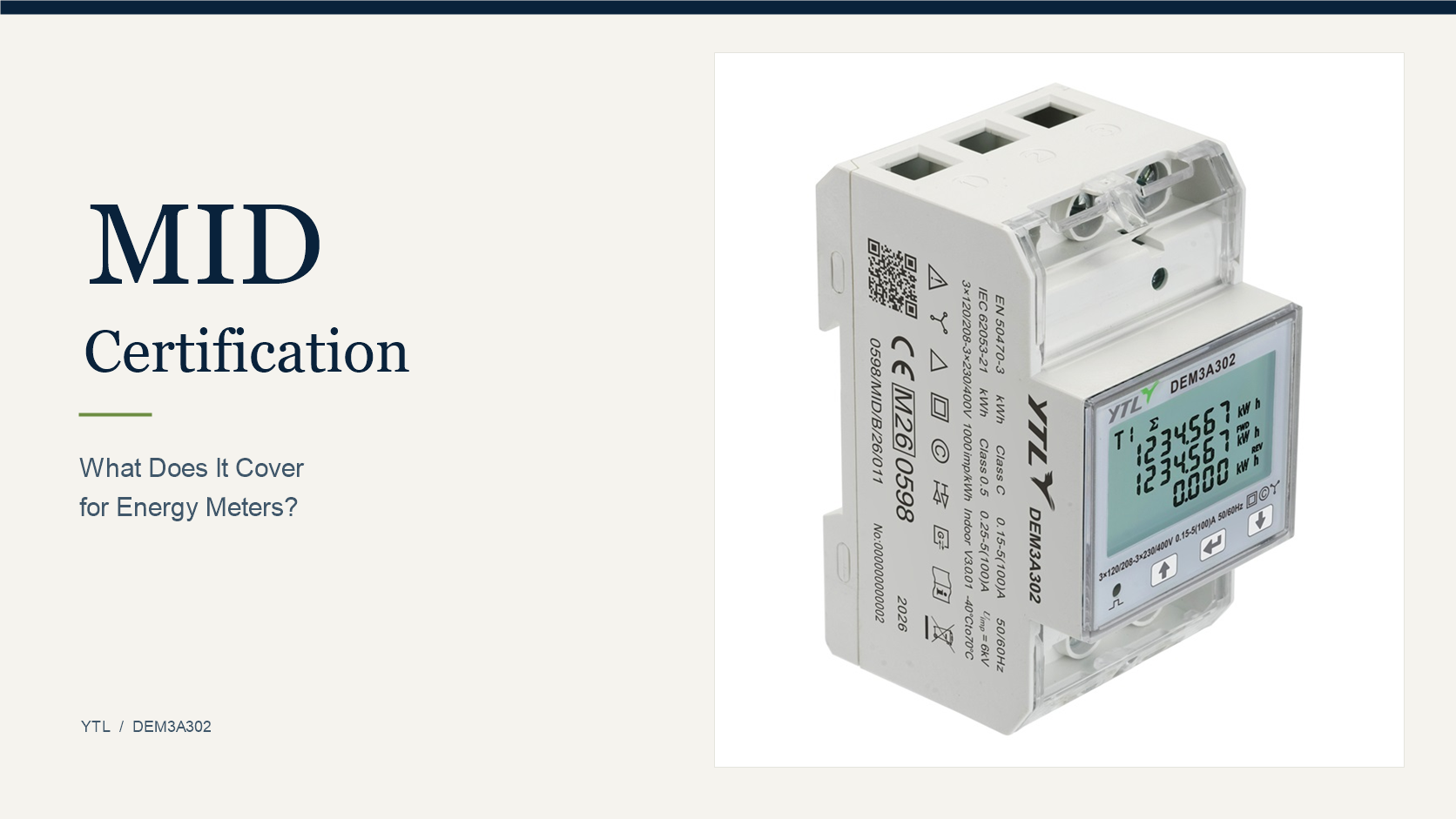
MID certification for an energy meter covers the legal metrology requirements for one defined meter type. Those requirements are active-energy accuracy under specified conditions, protection of the measurement and its data, and the production controls of the conformity assessment route the manufacturer has chosen. Before you accept a MID claim for a project, match the certificate to the exact model and configuration you are ordering and check the production-stage documents that go with it.
What MID Certification Means for an Energy Meter
MID is the Measuring Instruments Directive 2014/32/EU, which harmonises legal metrology for instruments such as electricity meters used to bill customers. Its general requirements sit in Annex I. Annex V, known as MI-003, adds the requirements for active electrical energy meters for residential, commercial and light industrial use. Two limits apply before you rely on a MID claim:
- The approval belongs to a defined instrument type, so only the certificate and its annexes show which models, firmware versions and optional functions are covered.
- Article 3 lets Member States prescribe measuring instruments for measuring tasks where they consider it justified, so confirm the destination country’s rules for the actual billing or sub-billing arrangement.
What Does MID Assess?
MID assessment checks whether a meter delivers the required metrological performance within its declared conditions and protects that performance against disturbance or intervention.
Accuracy Within Specified Operating Conditions
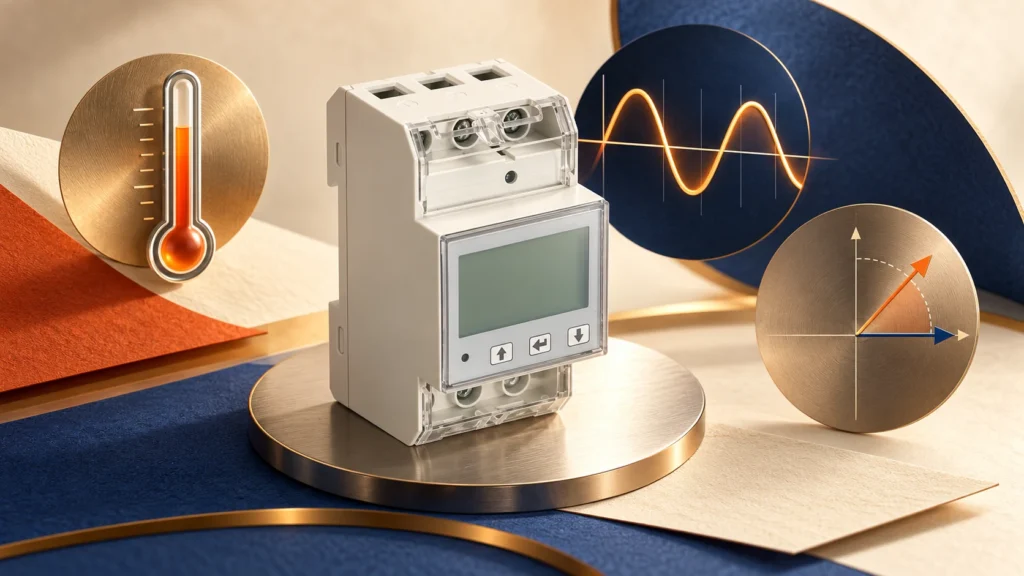
MI-003 uses accuracy classes A, B and C, and the permissible errors depend on the class and on operating conditions such as current, temperature and, for AC meters, power factor. MID therefore does not give a certified meter one fixed error under every condition. Read the declared current range and voltage alongside the class, since a MID claim on two products does not let a direct-connected meter rated for one circuit serve a higher-current one. For transformer-operated measurement, the meter’s input also has to match the selected transformers.
Protection of the Measurement and Its Dat
Annex I, section 8, requires protection of metrologically important hardware, software, parameters and measurement data against corruption. It also states that connecting another device must not influence the meter’s metrological characteristics in any inadmissible way. Before you apply a firmware or configuration change, check whether it touches the approved metrological design. A communication port or update facility does not give unrestricted permission to alter protected measurement functions.
Why Module B Is Only Part of the Evidence
Module B is the EU-type examination, in which a notified body examines the technical design of the meter. For MI-003 the manufacturer chooses between the routes B+F, B+D and H1, so a Module B certificate on its own does not show that the whole route has been completed.

| Module | What it addresses | What the buyer should establish |
|---|---|---|
| B | Examination of the technical design | The exact type, configuration and certificate annexes |
| D | Conformity to type based on production-process quality assurance | Production-stage approval covering the supplied instruments |
| F | Conformity to type based on product verification | Verification covering the supplied instruments |
| H1 | Full quality assurance plus design examination | Design and production coverage under that route |
Once conformity has been demonstrated, the manufacturer draws up the EU declaration of conformity and applies three markings under Articles 21 and 22:
- The CE marking.
- The supplementary metrology marking: a rectangle with the capital letter M and the last two digits of the year it was affixed.
- The identification number of the notified body involved in the production control phase, which need not match the body that issued the Module B certificate.
Where the Scope Stops
A meter can have functions and connected components that sit outside its MID assessment. Separate them when you specify the system:
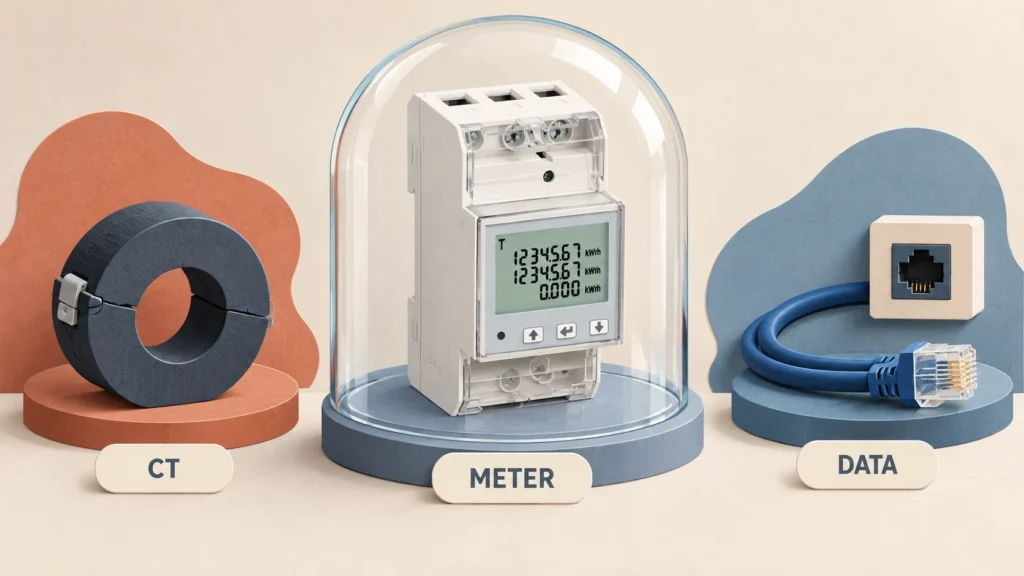
- Assess external current transformers (CTs) on their own evidence, because MI-003 covers the energy meter and not the instrument transformers used with it.
- Verify protocol settings, register definitions and software compatibility as a separate integration task; a value available over Modbus is not, by that alone, the legally relevant billing result.
- Check the evidence for voltage, current, reactive energy or power-quality values instead of extending the active-energy approval to every displayed figure.
- Establish data handling, installation and commercial-use requirements for the complete billing system independently of the meter’s type approval.
| Date | What changes |
|---|---|
| 10 April 2028 | Member States must have adopted and published their transposing measures |
| 10 October 2028 | Member States apply those measures |
| 10 April 2038 | Maximum transitional validity date under Article 2(3) of Directive (EU) 2026/706 for certificates within its specified scope and issued before 10 October 2028. These certificates remain valid until their own expiry dates, and in any event no later than 10 April 2038. |
DC Meters and EV Charging Systems
Directive (EU) 2026/706 amends the MID: it adds DC electrical energy meters to MI-003 and introduces a new annex, MI-011, for measuring systems in electric vehicle supply equipment. A meter’s conformity assessment and the assessment of a complete charging measuring system therefore have different scopes. For a DC or EV charging order, agree the applicable route and dates with the supplier.
Match MID Scope to the YTL Meter You Need
YTL’s priority DIN-rail meters cover single-phase direct connection, three-phase direct connection and transformer-operated measurement. Each is covered by an EU type-examination certificate under the Measuring Instruments Directive 2014/32/EU (Module B), issued by SGS Fimko Oy, Notified Body 0598:
| YTL model | Connection and current rating | Nameplate class | EU type-examination certificate |
|---|---|---|---|
| DEM1E302 | Single-phase direct, up to 45 A | EN 50470-3 Class C | DEM1E302: 0598/MID/B/25/114 |
| DEM2A302 | Single-phase direct, up to 100 A | EN 50470-3 Class C | DEM2A302: 0598/MID/B/25/105 |
| DEM3A302 | Three-phase direct, up to 100 A | EN 50470-3 Class C | DEM3A302: 0598/MID/B/26/011 |
| DEM3K302 | Three-phase CT/PT-operated, 5 A basic and 6 A maximum input | EN 50470-3 Class C | DEM3K302: 0598/MID/B/26/010 |
The same certificates also list the 001 and 202 versions of each series. For any other YTL meter, check the certificate for its model series before you shortlist it. Then ask us for the full certificate and declaration of conformity for your variant, and confirm which production-stage module covers the meters you will receive.
RS485 Modbus RTU compatibility and time-of-use (TOU) functions should be checked separately from active-energy accuracy certification. However, metrologically relevant software, parameters and protected measurement data may form part of the approved meter design. The exact scope should be confirmed against the certificate and its annexes. For the DEM3K302, include the CT ratios in the review, since its 6 A maximum input is not the primary circuit’s rating.
Check the Documents Before Placing an Order
Make the document review part of model selection, so the quotation, the approval evidence and the supplied meter all describe the same product.

- Match the model designation and manufacturer to the EU type-examination certificate and its annexes.
- Check the approved electrical ratings, connection method, software identification and restrictions against the order configuration.
- Obtain the applicable production-stage evidence and the EU declaration of conformity.
- Compare the proposed nameplate markings with the documents and identify each notified body’s role.
- Confirm the destination country’s requirements for the intended measurement and billing task.
- Request a model-specific quotation with the certification documents, stating the destination country, phase arrangement, voltage and current range, connection method, communication needs and whether you will bill another party.
FAQ
Is a MID-Certified Meter More Accurate Than a Non-MID Meter?
Not automatically. MID conformity covers legal metrology requirements, not a ranking of accuracy, so a MID mark alone does not show that one instrument measures more accurately than another. Compare the declared accuracy class, its reference standard and the operating conditions.
Does MID Certification Replace a Calibration Certificate?
No. A calibration certificate reports the measured error and uncertainty of one identified meter, while MID concerns the regulatory requirements and assessment route for its type. If your acceptance specification needs individual calibration results, request that evidence separately.
Can the Total kWh Register on a MID Meter Be Reset?
Not during use. Annex I, section 8.5, requires that for utility measuring instruments the display of the total quantity supplied, or the displays from which it is derived, cannot be reset during use. A separate resettable partial counter is a different function, so check which register your system bills from and how it is protected.
Source
- Directive 2014/32/EU on the harmonisation of the laws of the Member States relating to the making available on the market of measuring instruments (recast), EUR-Lex: Article 3, Articles 21 and 22, Annex I section 8, Annex II Module B and Annex V (MI-003).
- Directive (EU) 2026/706 amending Directive 2014/32/EU as regards measuring systems for electric vehicle supply equipment and compressed gas dispensers, and electricity, gas and thermal energy meters, EUR-Lex: DC meters in MI-003, new annex MI-011, transposition dates and certificate transition.