









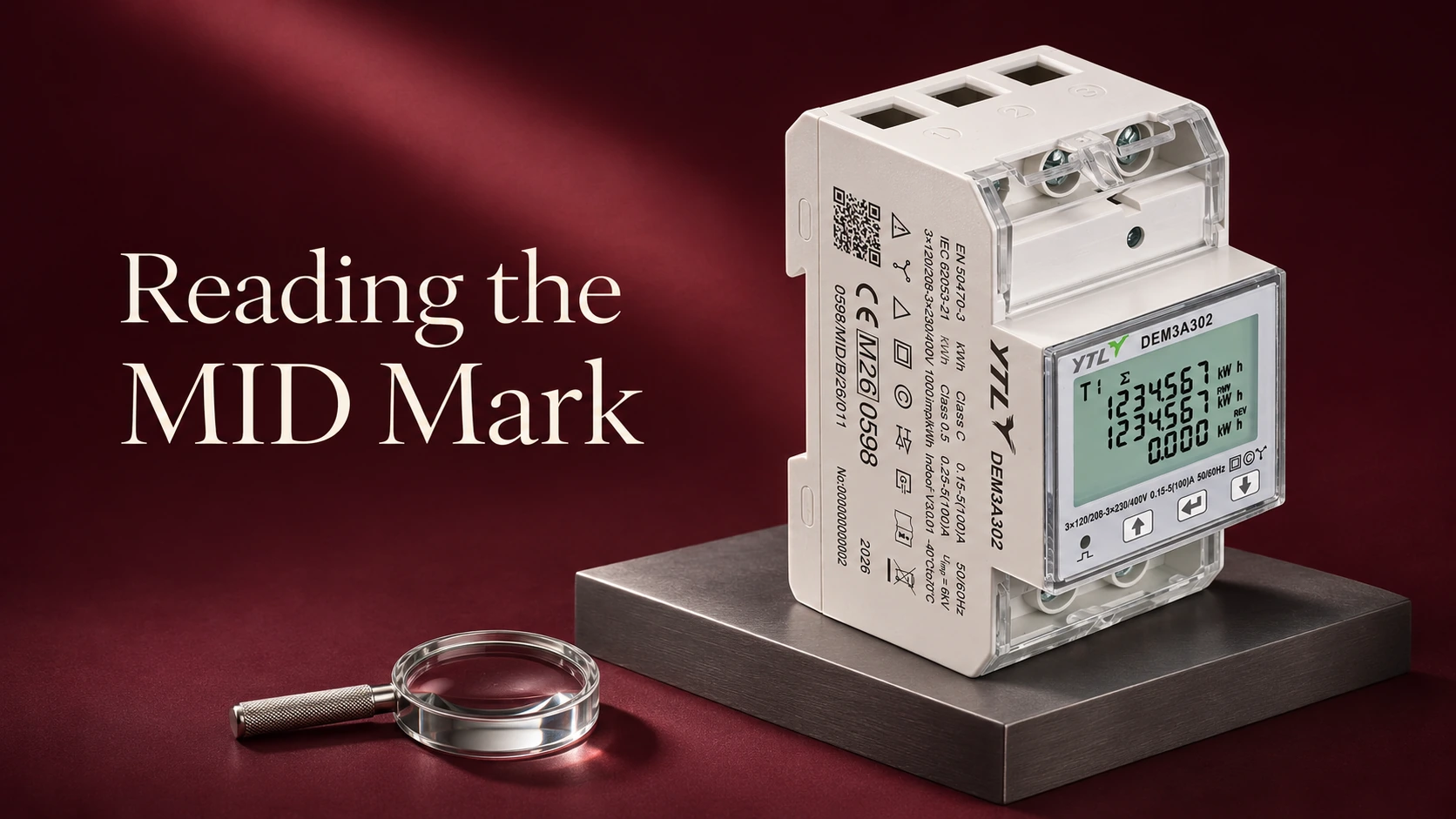
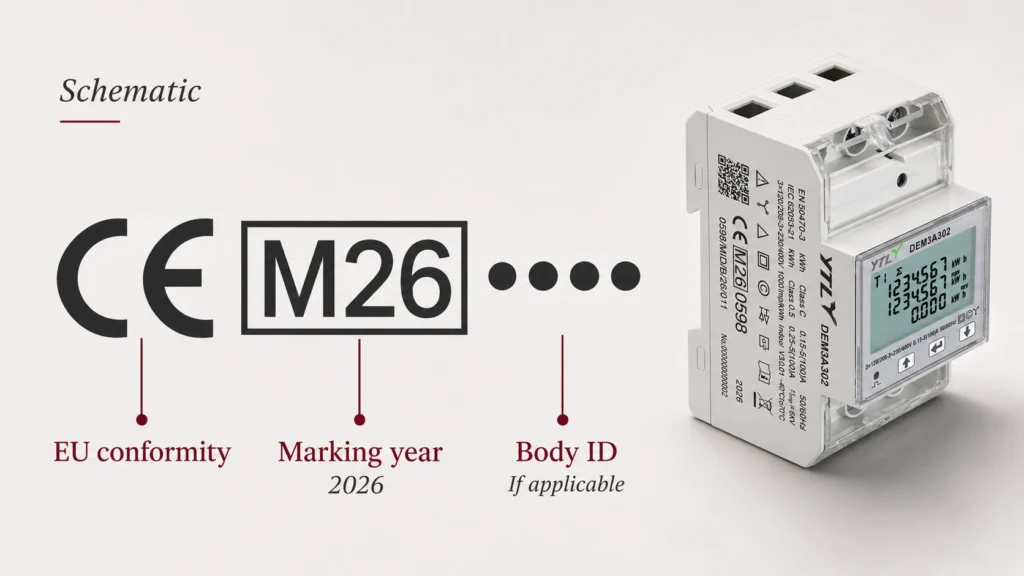
To read the MID marking on an energy meter, find the CE marking and the capital M with two digits inside a rectangle beside it. Where the conformity route requires one, a four-digit notified body number follows both. Under the EU Measuring Instruments Directive (MID), the two digits give the year the marking was affixed, so M26 means 2026. The marking shows that a conformity claim has been made, while the meter’s documents show what that claim covers, so match the two before you rely on the meter for a project.
What Does an MID Mark Look Like on an Energy Meter?
An MID-marked meter carries up to three elements in a fixed order: CE, the supplementary metrology marking and the notified body’s identification number. The supplementary marking is a capital M and the last two digits of the year, inside a rectangle the same height as the CE marking. Each element answers a different question:
| Element on the meter | What it tells you | What it does not tell you |
|---|---|---|
| CE marking | The manufacturer declares that the product meets the EU requirements that call for CE marking | Which directive applies, since CE appears on many types of product |
| M with two digits, for example M26 | The marking was affixed under the MID in 2026 | The date of the last calibration or any in-service expiry date |
| Four-digit number after the M marking | The notified body involved in the production control phase, where the route includes one | The serial number, the certificate number or the body that examined the design |
The last row catches buyers out. The number after the M marking need not belong to the body that issued the EU type-examination certificate, because the manufacturer can choose a different notified body for each assessment module. To see which body did what, compare the certificate with the production-stage documents. Then look each number up in the European Commission’s NANDO database, which lists every notified body’s number and the tasks it is notified for. A listing confirms the body’s designation; it says nothing about an individual meter.
Where to Find the MID Marking
Look on the meter itself or its data plate first. Article 22 of the MID requires the CE and supplementary metrology markings to be visible, legible and indelible on the instrument or its data plate. Only where that is not possible or not warranted may they go on the accompanying documents and packaging instead. Annex I also lists the EU type-examination certificate number among the inscriptions a meter bears where applicable, so the same plate usually gives you the number to match. On an installed meter, read and photograph the label without opening the enclosure or breaking any seal.

How to Check the Marking Against the Meter’s Documents
The label ties a physical meter to its paperwork, which matters most when the meter will be used to bill someone. Work through the documents in this order:
- Record the manufacturer, full model, variant, serial number and certificate number shown on the meter.
- Check that the EU declaration of conformity supplied with the meter names this model and the MID.
- Compare the model, ratings and dates on the EU type-examination certificate with the meter and its configuration.
- Request the production-stage documents, because a Module B certificate covers the design only and electricity meters complete the route through B+D, B+F or H1.
- Resolve any gap between the label and the documents with the supplier before you order, and file the confirmed set with the order records.

A series name in a catalogue rarely identifies the exact configuration, which is why step 1 starts from the meter rather than the brochure. Keep a calibration certificate separate in the file: it reports measured errors for one instrument at stated test points and does not replace any of the conformity documents above.
What the Marking Cannot Confirm on Its Own
The marking states a conformity claim for the instrument. It does not prove that the label is genuine, and it does not tell you whether the meter suits your circuit or your billing task. Use the model data and installation records for those questions:
| Question | What to check |
|---|---|
| Does the meter fit the circuit? | Phase, wiring, current range, accuracy class and the communication interface the system needs |
| Is it suitable for the planned billing task? | The measurement task and the requirements of the destination country and installation |
| Is the installed meter still measuring correctly? | The in-service checks and records that apply to that meter |
Annex V of the MID defines accuracy classes A, B and C for active electrical energy meters. Read the class together with the operating conditions in the meter’s documents, and remember that a class describes permitted errors, not conformity.
Choosing a YTL DIN-Rail Meter for Your Project
Each of YTL’s four priority DIN-rail meters is covered by its own EU type-examination certificate under the Measuring Instruments Directive 2014/32/EU (Module B), issued by SGS Fimko Oy, Notified Body 0598. The certificate number to look for depends on the model:
- DEM1E302, single-phase direct, up to 45 A: 0598/MID/B/25/114.
- DEM2A302, single-phase direct, up to 100 A: 0598/MID/B/25/105.
- DEM3A302, three-phase direct, up to 100 A: 0598/MID/B/26/011.
- DEM3K302, three-phase CT-operated, 5(6) A CT input: 0598/MID/B/26/010.

Each certificate also lists the 001 and 202 versions of the same series. When you ask YTL for the full certificate and declaration of conformity, name the destination country, model, configuration and whether the readings will bill another party. Ask for the production-stage documents your project needs at the same time.
FAQs
Does the MID Marking Expire?
No. The M marking records the year it was affixed and carries no in-service expiry date. Whether an installed meter needs re-verification or replacement depends on the rules of the country where it is used, which can set verification periods for meters used in billing.
What If the MID Marking Is Missing or Unreadable?
Record the model and serial number you can see, then ask the supplier or manufacturer for the matching documents. Do not break seals or dismantle an installed meter to look for the marking. Until the product and its documents have been matched, do not rely on the meter for a regulated measurement task.
Does a Meter’s MID Marking Cover an Entire EV Charging Station?
No. A meter’s marking concerns that meter and its documented scope, not every requirement that applies to the charging station around it. Directive (EU) 2026/706 adds requirements for the measuring system of electric vehicle supply equipment, which covers more than the meter. Member States must transpose it by 10 April 2028 and apply it from 10 October 2028, with transitional arrangements.
Source
- Directive 2014/32/EU on the harmonisation of the laws of the Member States relating to the making available on the market of measuring instruments (recast), EUR-Lex: Articles 19, 21 and 22, Annex I point 9.1, and Annex V (MI-003) accuracy classes.
- We Ensure Conformity, National Standards Authority of Ireland: Module B as design examination that must be followed by a production module such as D or F.
- MIR approved gas and electricity meters, Office for Product Safety and Standards: B+D, B+F and H1 as the routes for electricity meters.
- CE marking, European Commission: what the manufacturer declares by affixing CE.
- Notified bodies, European Commission: the NANDO list of notified body numbers and tasks.
- Directive (EU) 2026/706 amending Directive 2014/32/EU as regards measuring systems for electric vehicle supply equipment and compressed gas dispensers, and electricity, gas and thermal energy meters, EUR-Lex: EVSE measuring systems added to the MID.
- Explanatory note on Directive (EU) 2026/706, Department for Business and Trade: transposition and application dates.
