









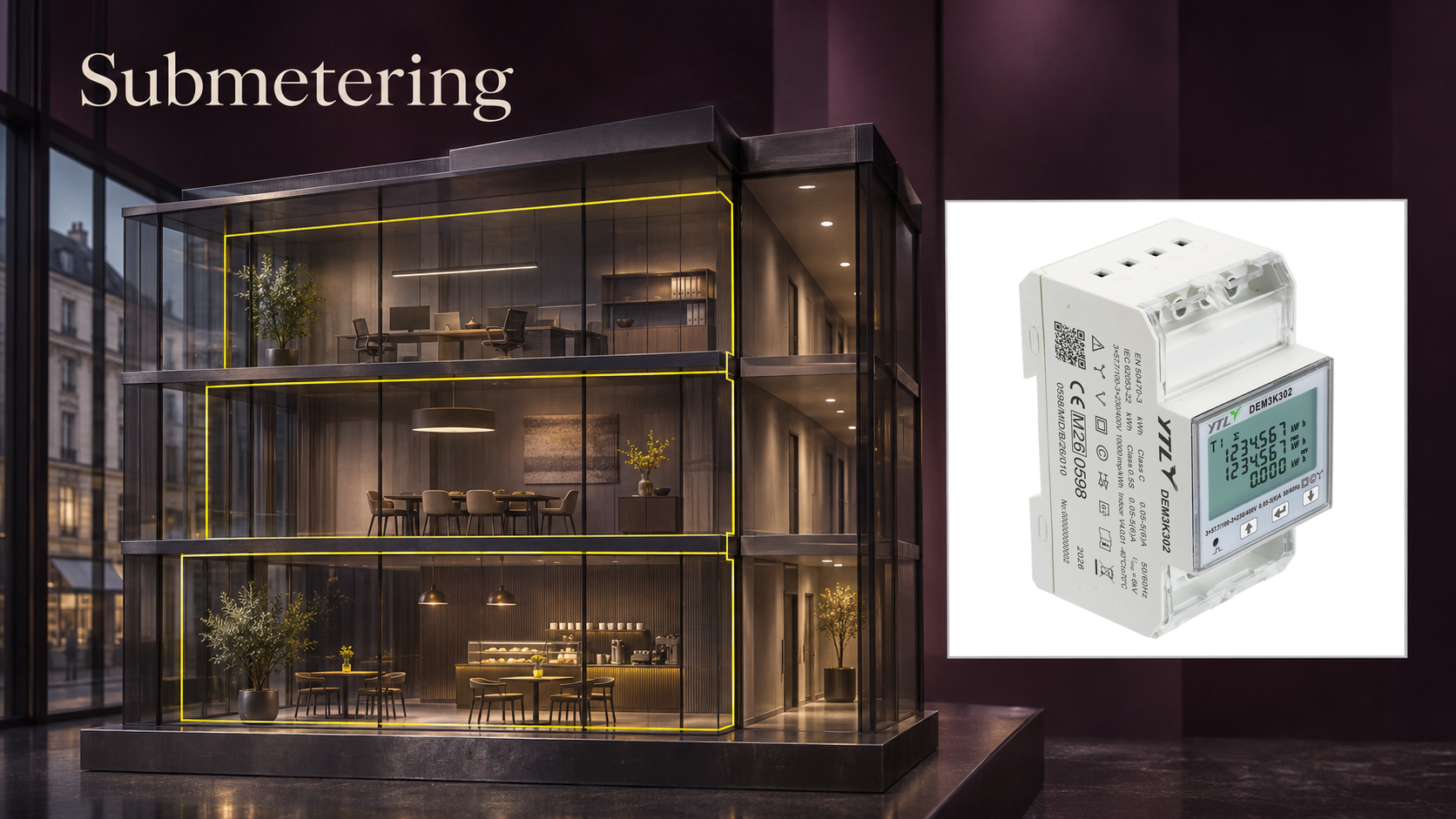
Submetering measures a defined part of a building’s utility consumption. Electricity submeters sit downstream of the main meter and record the energy used by a tenant, area, process or piece of equipment in kilowatt-hours (kWh). These separate records support cost allocation and show where electricity is being used.
How Electricity Submetering Works
The main meter records electricity at the building’s supply point, while submeters measure energy on tenant feeders or equipment circuits downstream. Each reading covers the loads supplied through that point, so a submeter upstream of several tenants records their combined use.
To find the imported energy for a period, subtract the opening reading from the closing reading of the same cumulative import-energy register, provided it has not been reset or rolled over. Record the meter identity and both timestamps, and handle any meter replacement or counter discontinuity separately. Staff can read the display locally, or a gateway or compatible controller can collect the same data and pass it to reporting software.
Where Submetering Adds Useful Detail
Submetering pays off when a whole-building total is too broad for the decision in hand, so place each meter where its record answers a specific operational or allocation question:
| Question | Useful measurement point | What the record supports |
|---|---|---|
| How much electricity does each tenant use? | Each tenant’s dedicated electrical supply | Consumption-based allocation for that defined tenancy |
| How much do shared services consume? | Common-area lighting, ventilation or other shared-service circuits | A separate record for the agreed common-cost allocation |
| Which department or production process uses the energy? | The feeder or circuits serving that department or process | Comparisons against operating hours or production activity |
| What runs outside normal working hours? | The equipment or system being investigated | A time-based review of overnight and weekend use |
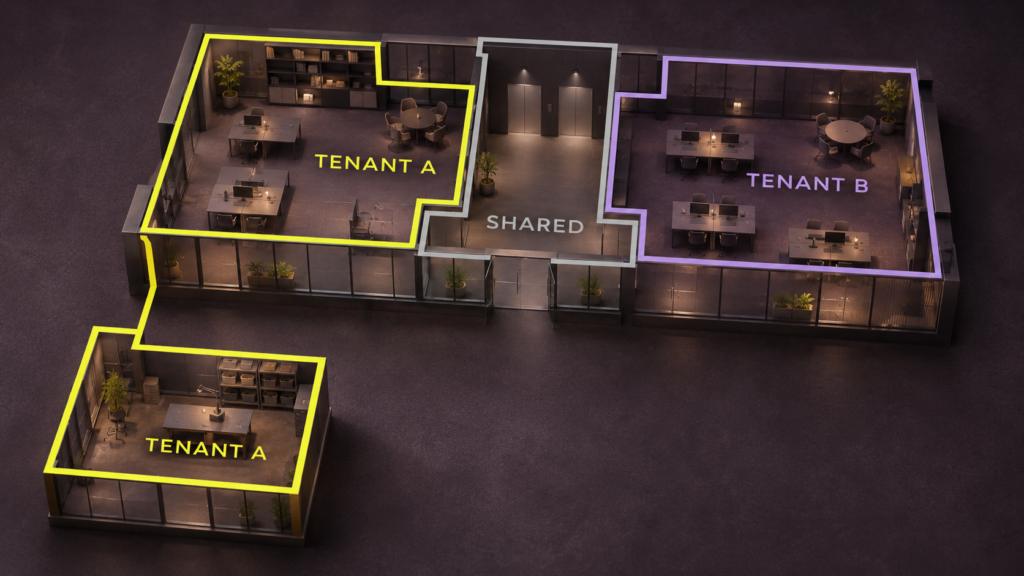
A floor is not automatically a tenant boundary. If a tenant occupies part of one floor and also uses a workshop elsewhere, a floor meter will not capture that tenant’s full consumption on its own. The electrical drawing and the allocation rule have to describe the same boundary.
Turn Meter Readings Into Decisions
Cost allocation needs a traceable consumption record and an agreed charging rule. Operational decisions also need context about when and how the equipment was used.
Cost Allocation and Tenant Billing
Keep the tenant’s directly measured energy separate from any allocated share of common-service consumption. The bill depends on that measured energy, the applicable tariff and the agreed treatment of shared costs or other charges. Record the charging rules alongside the meter readings so each part of the calculation stays clear.

Billing adds a regulatory check. For EU projects, confirm the selected meter’s Measuring Instruments Directive (MID) documentation and the destination country’s requirements. In Great Britain, the Measuring Instruments Regulations apply instead, and Office for Product Safety and Standards (OPSS) guidance sets out which approvals cover landlord-to-tenant billing. State the intended billing use in the product enquiry, before the order is approved.
Energy Management and Equipment Operation
Use time-based records to compare electricity use with the activity it serves. If ventilation keeps drawing power after the building closes, examine its operating schedule and controls, and give someone the job of acting on the finding. For a production process, look at consumption alongside output and operating hours before judging efficiency. After an operational or maintenance change, repeat the comparison under similar operating conditions: a lower total caused by shorter operating hours does not by itself show that the equipment has become more efficient.

Plan for Usable Data From the Start
Assign each meter a circuit, a data route and a person responsible for using its records. Those links keep readings traceable when the building or the reporting system changes.
Define the Measurement Boundaries
Draw the boundaries on the distribution drawing before anyone orders hardware:
- Mark each proposed meter with its identity, circuit and reporting purpose.
- List the loads each meter covers and any supplies to the same tenant or process that enter elsewhere.
- Add only non-overlapping branches when forming a total, because a floor meter already includes the equipment submeters beneath it, and use the parent meter to check that total.
- Match the phase, voltage, circuit current and direct or current-transformer (CT) connection to each point before choosing DIN-rail submeters for it.
Collect and Check the Records
Set a collection interval that suits the task. Periodic cumulative readings can support consumption totals, while investigating short periods of unusual operation needs more frequent records. Decide where the data will be stored and who will review gaps or unexpected values.
For RS485 integration using Modbus RTU (Remote Terminal Unit), request the register map for the exact model and configuration. Device mapping is manufacturer-specific, so configure the receiving system with the correct addresses, units and interpretation, then confirm the meter identity, registers and timestamps at commissioning. On CT-operated points, establish whether the readings already include the configured CT ratio before applying any further scaling, and compare the meter display with the collected value on the same basis.
Where YTL Fits in Your Submetering Project
YTL’s standard DIN-rail meters provide the measuring hardware for commercial and industrial submetering. Two models cover the most common points in a tenanted building:
- DEM1E302 for single-phase tenant or equipment circuits up to 45 A, in an 18 mm module.
- DEM3K302 for three-phase feeders through external CTs, with a 5 A basic and 6 A maximum CT input and CT ratios configurable up to 2000:1.
Both show readings on a local LCD and provide RS485 Modbus RTU communication and time-of-use energy recording for a compatible monitoring system. The wider DIN-rail energy meter range adds 100 A single-phase and three-phase direct-connected models.

To get matching model documentation and a standard-product quotation, send us the proposed metering points with their electrical ratings, the destination country, the intended data use and the expected quantity.
FAQ
Does Submetering Need an Internet Connection?
No. Local readings and an on-site RS485 collection network can work without internet access. Remote access depends on the connection required by the selected gateway and reporting platform.
Why Do the Submeters Not Add Up to the Main Meter?
The comparison is rarely like for like: shared or unmetered circuits, different energy registers, incorrect CT scaling, missing records and mismatched reading periods all open a gap. Compare the same period and measurement boundaries first, and if the difference remains unexplained, have the installation and measurement arrangement assessed before assigning it to any tenant or declaring a meter inaccurate.
Does Submetering Require Prepayment?
No. Readings can support monitoring or billing after use. If payment before use is required, specify the credit and payment workflow, compatible metering hardware and any supply-control equipment separately.
Source
- Directive 2014/32/EU on the harmonisation of the laws of the Member States relating to the making available on the market of measuring instruments (recast), EUR-Lex: the EU MID framework and Member States’ right to prescribe instruments under Article 3.
- MIR approved gas and electricity meters, Office for Product Safety and Standards: the separate Great Britain approval framework and its limits for landlord-to-tenant billing.
- MODBUS Application Protocol Specification V1.1b3, Modbus Organization: vendor-specific mapping of the data model (sections 4.3 and 4.4).
