









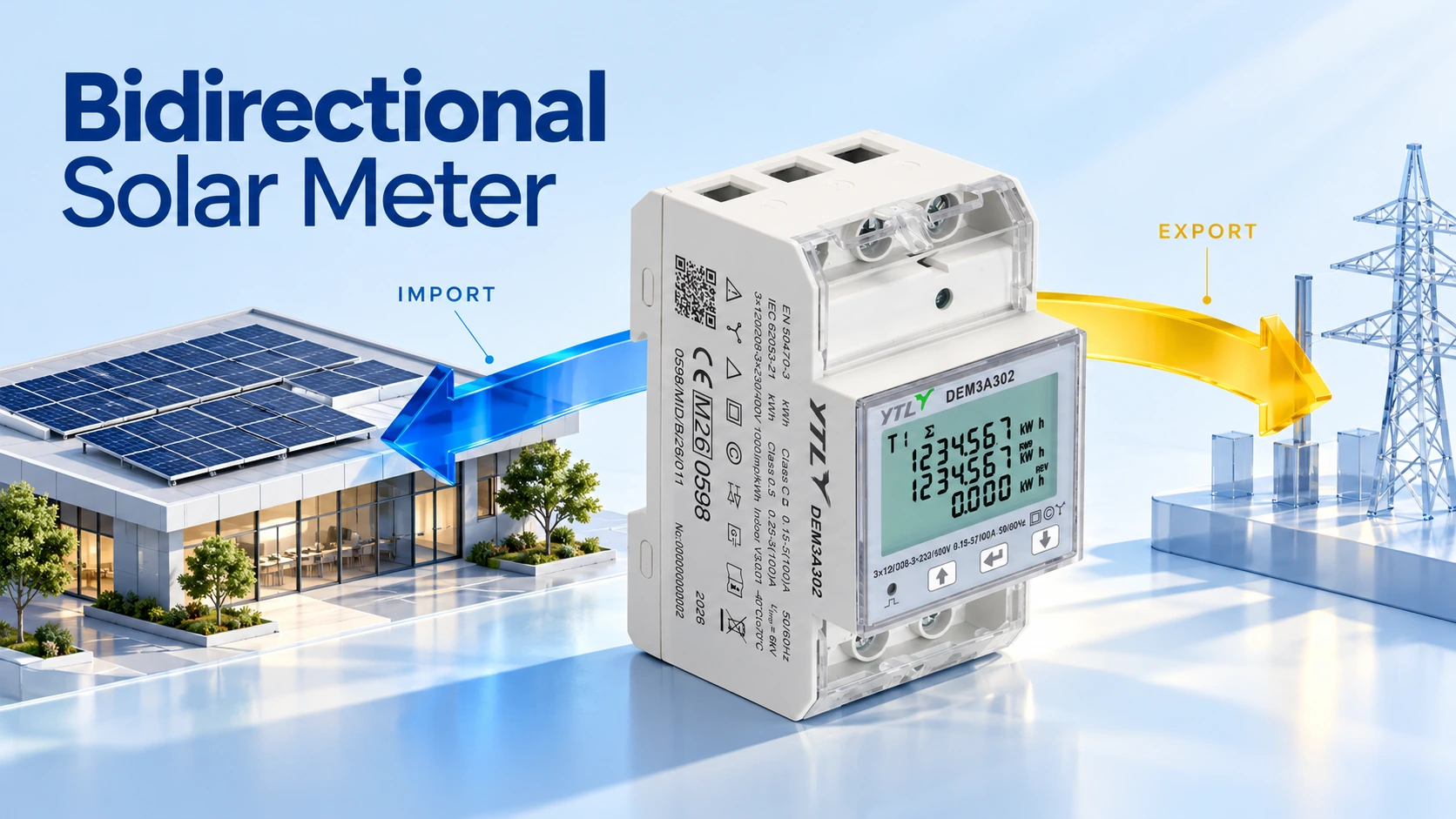
A bidirectional solar meter measures the electricity a site imports from the grid and exports back, working out which way active power flows at each moment and adding the energy to a separate kilowatt-hour (kWh) counter for each direction. Each counter normally counts upwards until it is reset or rolls over, and the direction of flow decides which one moves.
What a Bidirectional Solar Meter Records
Picture a small office with solar panels on the roof, on a bright day with no battery. Through the morning the building uses everything the panels make and the grid tops up the rest, so the meter counts import. By early afternoon the panels are making more than the building needs, and if export is allowed the surplus flows out to the network, so the meter counts export. In the evening the panels stop and the flow turns round again.
What those readings mean depends on where the meter sits: at the grid connection it measures the site’s exchange with the network, on a single feeder only that feeder. Mark the measurement point on the single-line diagram before you choose the meter, because the same two counters answer different questions in different places.
How the Meter Tells Import From Export
An electronic meter calculates active power from the voltage and current it measures, then accumulates energy over time and assigns it to a counter according to the direction of that power and the calculation mode you have set.
Finding the Direction of Active Power
The sign of active power gives the direction; current alone won’t do, because AC current reverses many times a second whichever way the energy is going. Where the reference direction runs from the grid towards the site’s loads, import is positive and export negative. Check that the meter’s convention matches the import and export labels in the energy management system (EMS), or the two will disagree about which way the site is trading.
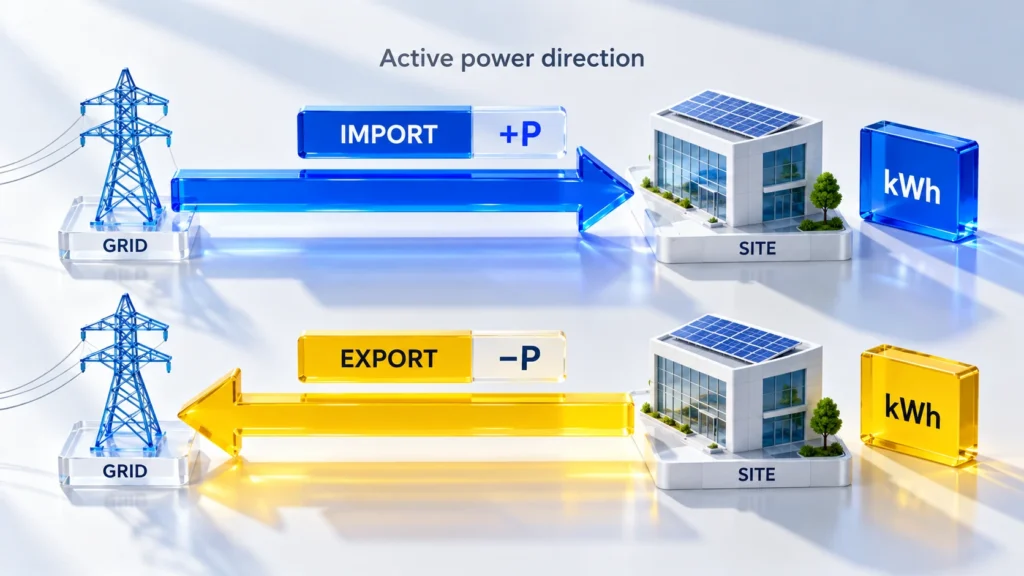
On a meter with current transformers (CTs), the installation sets the reference too: each CT has to face the right way and pair with its own phase voltage, since a reversed CT turns that phase’s import into export. During commissioning, compare what the meter reports with a condition you know, such as a moment when the site is clearly importing.
Adding Energy to the Right Counter
Power in kilowatts (kW) is the rate of transfer; energy in kWh is the amount transferred. A steady 2 kW flowing for 30 minutes moves 1 kWh, and the direction of that flow decides whether it lands in the import or the export total.
The import and export registers accumulate separately, while the main displayed total depends on the calculation mode: it can show one direction, both added together, or one offset against the other. Check which mode is set, and compare the meter with the EMS only on the same named register, before anyone starts quoting figures.
How to Read Import, Export and Net Energy
For each cumulative counter, subtract the opening reading from the closing reading of the same counter, using matching timestamps and units and with no reset or rollover in between. In this made-up reporting period, the counters move like this:

| Counter | Opening reading | Closing reading | Energy in the period |
|---|---|---|---|
| Import | 1,250 kWh | 1,262 kWh | 12 kWh imported |
| Export | 640 kWh | 648 kWh | 8 kWh exported |
With net energy defined as import minus export, the site was a net importer of 4 kWh; add the two instead and you get an absolute total of 20 kWh. Each figure answers a different question: how much came in, how much went out, and what was left after one was set against the other. None of them decides the bill on its own, since import charges and export payments follow the site’s supply and export arrangements, which may price the two directions differently.
On a three-phase site, suppose a single-phase inverter on L1 pushes 2 kW out through that phase while loads on L2 and L3 draw 1 kW each. Summed across the three phases, the flows cancel to zero; counted phase by phase, the site imported 2 kW and exported 2 kW at the same moment. Over an hour that is 2 kWh in each direction or nothing at all, depending on how the meter combines the phases, so check this in the datasheet and register map before you interpret the totals.
Why Grid Export Differs From Solar Generation
Solar electricity used on site never crosses the grid connection, so the export counter never sees it. Take an AC-side example without storage, ignoring losses: the panels generate 100 kWh, the building uses 70 kWh, and the export counter records only the 30 kWh that reaches the grid. That is why a solar installation can have two meters: a generation meter for PV output at its own point, and a grid-side meter for the exchange with the network. Energy Saving Trust’s case study of a home installation in Edinburgh describes exactly this pair, with the import-export meter fitted by the energy supplier.

A battery adds charging and discharging paths, and the grid meter alone can no longer tell you where the energy went. When you plan solar PV and storage metering, define the generation, battery and grid measurement points separately so that each reading has one clear job.
Choosing a YTL Meter for the Measurement Point
For a grid-side or feeder measurement, our four standard DIN-rail meters cover single-phase and three-phase circuits. Each is listed as an import/export kWh meter on its EU type-examination certificate under the Measuring Instruments Directive 2014/32/EU (Module B), issued by SGS Fimko Oy, Notified Body 0598.

All four offer five accumulation modes, including forward only, reverse only, absolute value (forward plus reverse) and algebraic sum (forward minus reverse). At commissioning, check four things:
- Match the mode to the question the reading answers, using the names in your model’s register map.
- Read the separate import and export registers, not the combined total, when the EMS needs both directions.
- Size the DEM3K302 with its CTs: the 6 A limit applies to the CT input, not the primary circuit, and each CT must face the right way.
- Allow for delay beyond the meter: the ≤75 ms RS485 communication refresh time covers only the meter’s side, before gateway polling and controller processing.
To discuss a meter for your site, send us the single-line diagram with the voltage, operating current range, controller model, the import and export readings you need and, where relevant, the CT details. Ask for the full certificate and the declaration of conformity for your variant at the same time.
FAQs
Is an Export Meter the Same as a Bidirectional Meter?
Often, but the name alone won’t tell you. All three names are used for meters that record energy leaving the site, yet some count only one direction or net the two in their main total, so look for separate import and export registers in the datasheet.
Does a Bidirectional Solar Meter Work at Night?
Yes. With its supply available, a grid-side meter keeps recording when the panels stop, so at night it counts the import that runs the site’s loads. Where there is a battery, charging and discharging can also change the grid exchange after dark.
Can a Bidirectional Solar Meter Prevent Export?
Not on its own: the meter measures the flow, and a compatible inverter or EMS uses that information to reduce output. Test the sensing, communication and controller response together through export-control testing, because checking the energy counters alone does not show that export is actually being limited.
Can a DIN-Rail Solar Meter Replace the Utility Meter?
Only if the local network operator or supplier accepts that exact meter and installation for settlement. A type-examination certificate covers the meter’s design and does not by itself mean the operator will accept it, so check the operator’s requirements for the project. A project can keep the utility meter for settlement and use a DIN-rail meter for operational data.
Sources
- Installing solar panels to help reduce your carbon footprint, Energy Saving Trust: the Edinburgh home with a separate generation meter and import-export meter.
- Directive 2014/32/EU, EUR-Lex: the Measuring Instruments Directive under which the four type-examination certificates were issued.
