
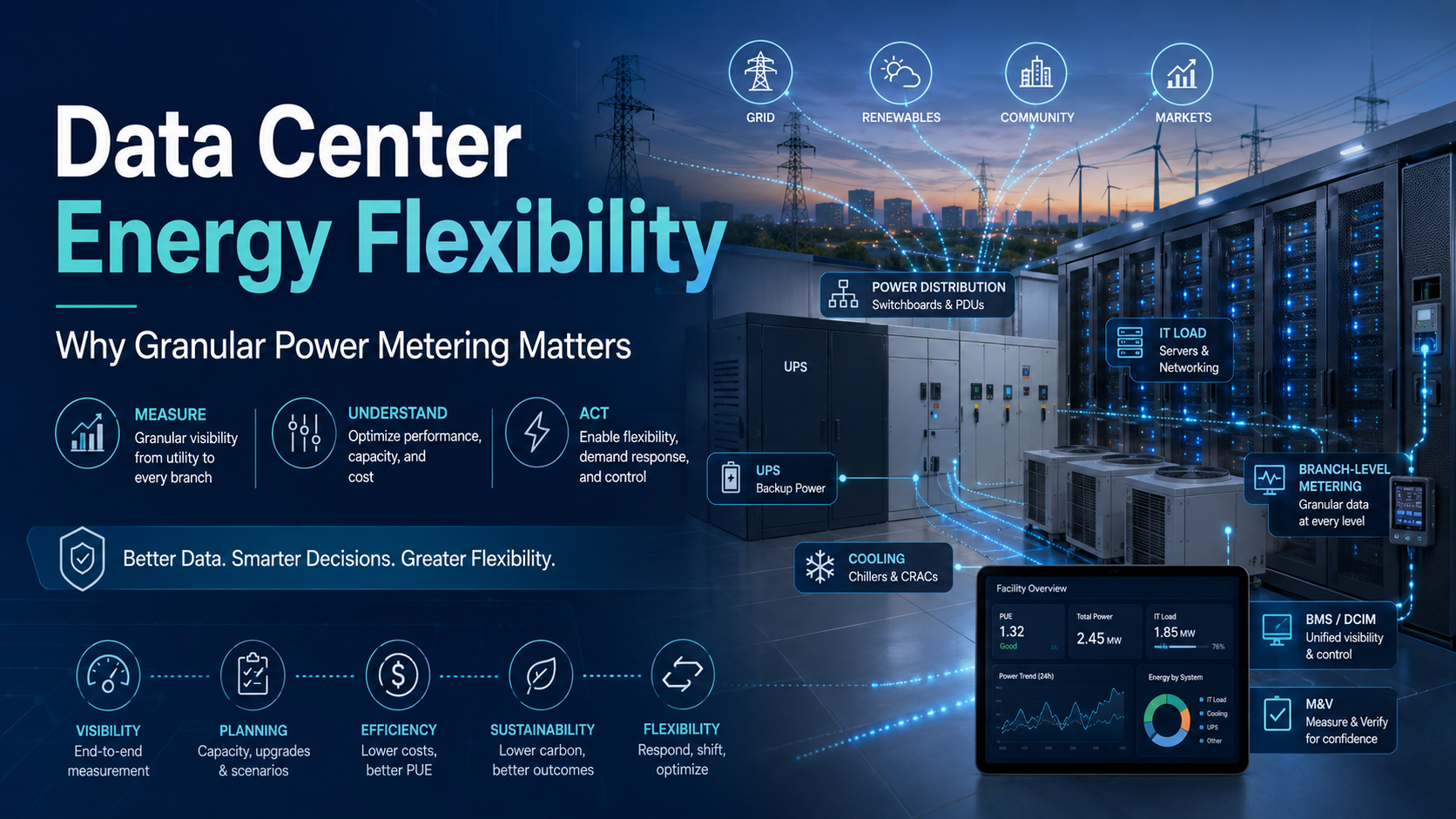
Data center grid integration is becoming a planning and operational challenge, not only an electricity-consumption issue.
On 3 June 2026, fourteen European industry associations from the data-center and energy sectors signed a Declaration of Intent under the coordination of the European Commission. They agreed to contribute to an EU model for tripartite agreements between data-center operators, energy-related parties and public authorities, with the aim of supporting more transparent and sustainable integration of data centers into the energy system.
The timing matters because data centers can be developed much faster than the grid infrastructure needed to connect them. The International Energy Agency reports that new data centers may take approximately one to three years to develop, while planning, permitting and completing new grid infrastructure may require five to fifteen years.
This mismatch increases the importance of:
- Grid-connection planning
- Efficient use of existing network capacity
- Load management
- Demand-side flexibility resources
- Clear measurement and verification
- Reliable facility-level and branch-level power data
For data center operators, EPC contractors, electrical panel builders and DCIM/BMS integrators, one practical question is becoming increasingly important:
Which electrical loads can be measured, separated and potentially managed without compromising reliability, safety or service-level requirements?
Granular power metering is a necessary data foundation for flexibility assessment and verification. However, it is not sufficient by itself.
Practical flexibility also requires controllable assets, defined operating limits, control systems, measurement and verification rules, operational approval and applicable market or contractual arrangements.
Why Data Center Grid Integration Is Becoming More Difficult
Data centers create large and concentrated electrical loads.
Unlike electricity demand distributed across many smaller users, a data center may require substantial capacity at one connection point together with strict power-quality, redundancy and uptime requirements.
Common challenges include:
- Limited grid-connection capacity
- Long lead times for substations and grid reinforcement
- Rapid growth in IT demand
- High cooling requirements
- UPS, generator and storage interfaces
- Stringent power-quality requirements
- Redundancy and uptime requirements
- Increasing energy-reporting expectations
- Potential participation in demand-response or flexibility programs
Demand response and other flexibility resources may help reduce peak demand, manage congestion and improve the use of existing grid assets. Actual participation depends on available controls, operating constraints, utility requirements, contractual arrangements and market design.
What Energy Flexibility Means for a Data Center
Energy flexibility is the ability to adjust the timing or amount of electricity consumption or on-site energy use in response to grid, market or operational conditions.
For a data center, flexibility does not mean reducing critical IT loads without considering uptime, redundancy and customer commitments. It may involve selected resources operating within approved technical and business limits.
Potential resources may include:
- Cooling-system optimization
- Chiller, pump or fan scheduling
- Thermal storage
- Battery energy storage
- UPS battery operation, where permitted by reliability, warranty, contractual and market requirements
- Generator or alternative-supply coordination, where permitted by reliability, environmental, contractual and market requirements
- Deferrable testing or maintenance loads
- Non-critical auxiliary systems
- IT workload shifting or scheduling, where supported by workload orchestration, latency requirements, service-level agreements and business approval
Not every load is flexible. Critical IT systems, life-safety equipment and redundancy functions may have strict operating limits.
Power meters do not decide which loads can be adjusted. Their role is to provide consistent electrical data for engineering analysis, control systems and performance verification.
Which Loads Should Be Separately Monitored?
A data center should not be treated as one undifferentiated electrical load.
A practical power-metering hierarchy may include:
Utility Supply / Grid Connection Point
→ Main Distribution
→ UPS Input and Output
→ IT Distribution
→ Cooling Systems
→ Auxiliary Systems
→ Generator and Energy-Storage Interfaces
→ Branch Circuits / Cabinets / Racks
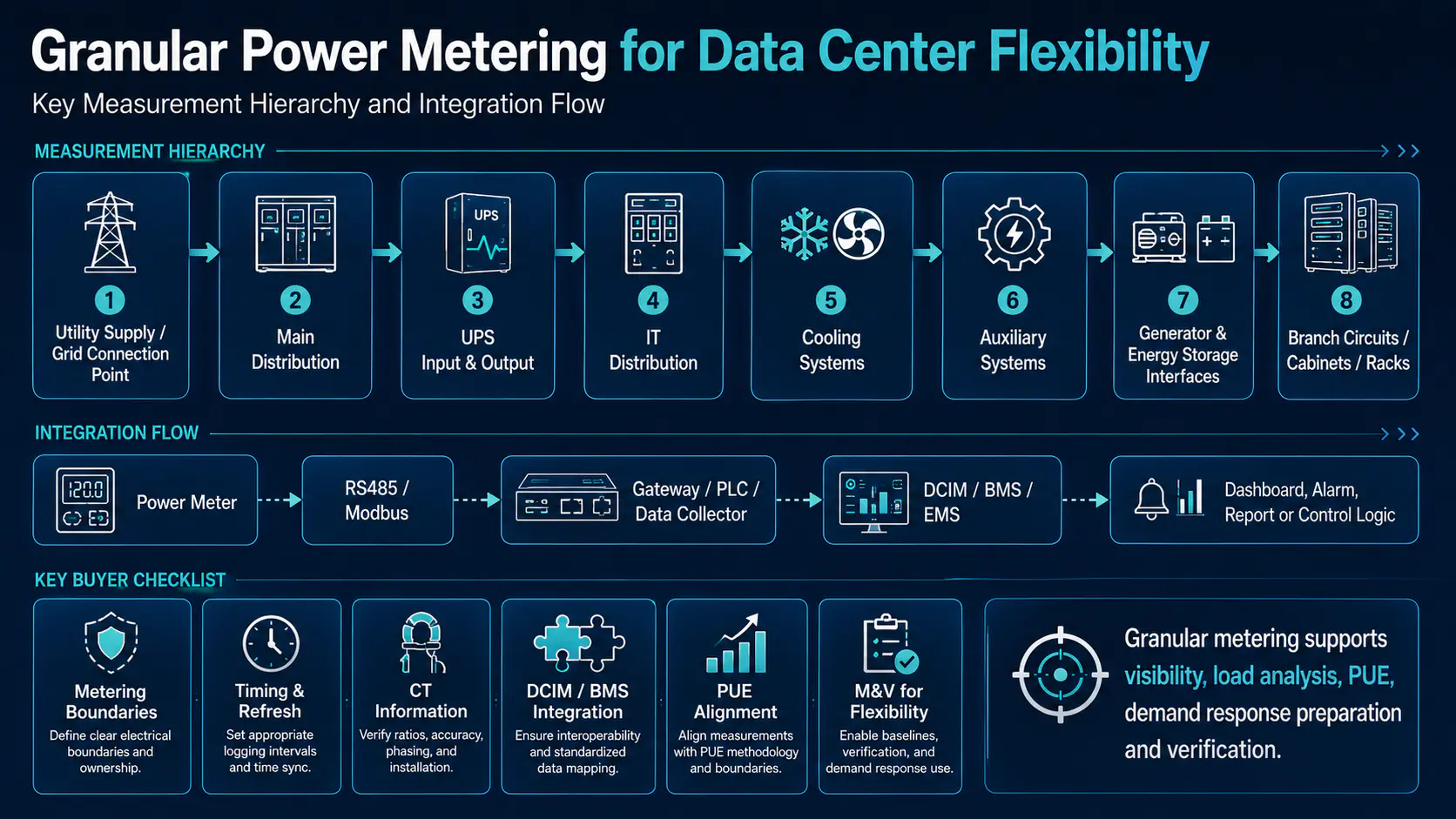
Important measurement points may include:
- Utility incomer
- Main low-voltage or medium-voltage distribution
- UPS input and output
- Power distribution units
- Remote power panels
- Busways and branch circuits
- Cabinet or rack feeds
- Chillers
- Cooling towers
- Pumps and fans
- Computer-room cooling equipment
- Lighting and auxiliary loads
- Generator output
- Battery-system or PCS electrical input and output at the project-defined AC or DC metering boundary
- On-site renewable-energy interfaces
The appropriate level of granularity depends on facility size, electrical architecture, monitoring objectives and DCIM/BMS design.
Utility, UPS, IT, Cooling and Auxiliary Loads
A utility-level meter shows total facility demand and energy consumption, but it does not explain how electricity is distributed internally.
Utility Supply and Main Distribution
Main incomer and distribution measurements can provide:
- Active energy
- Active power
- Demand
- Voltage
- Current
- Frequency
- Power factor
- Selected power-quality indicators, where supported
Detailed waveform capture, transient analysis, flicker measurement or standards-based power-quality analysis may require dedicated power-quality instruments rather than a standard energy or multifunction meter.
UPS Input and Output
Comparing UPS input and output can support analysis of:
- Conversion-loss trends
- Loading
- Indicative operating efficiency under defined conditions
- Redundancy behavior
- Changes in IT demand
Standard input and output energy or power measurements can support operational analysis and loss estimation, but they are not equivalent to UPS efficiency certification under standardized test conditions.
Measurement boundaries should also reflect the actual UPS topology, bypass arrangement and redundancy design.
IT Load
IT load may be measured at:
- PDU level
- Busway level
- Branch-circuit level
- Cabinet level
- Rack level
More granular information can help identify capacity distribution, phase imbalance and abnormal operating conditions.
Cooling Load
Cooling measurements may cover:
- Chillers
- Pumps
- Fans
- Cooling towers
- Computer-room air-conditioning equipment
- Other room-level cooling systems
Separating cooling from IT energy is important for energy analysis and potential flexibility studies.
Auxiliary Load
Lighting, office areas, security, fire-protection systems and other supporting services may be smaller than IT or cooling loads but can still contribute to total facility demand.
Backup Power and Storage Data Boundaries
Backup generation, UPS systems and battery storage may influence both facility reliability and potential grid interaction.
Electrical metering points may include:
- Generator electrical output
- Battery-system charge power
- Battery-system discharge power
- PCS electrical input and output at the defined AC or DC boundary
- Grid import and export
- On-site generation
- UPS input and output
Related operational data may include:
- Battery state of charge
- Battery state of health
- Generator operating status
- Fuel information
- UPS operating mode
- Equipment availability
- Alarm status
These operational values usually come from the battery-management system, generator controller, UPS controller or EMS rather than from a standard energy meter.
Import/export and charge/discharge sign conventions should be defined against a clear reference direction. Without a defined reference, a positive value may be interpreted differently by the meter, gateway, BMS, DCIM or storage-control platform.
Meter Data for DCIM and BMS
Power meters may send data to DCIM, BMS, EMS, PLC or gateway systems through interfaces such as RS485 and Modbus.
Power Meter
→ RS485 / Modbus
→ Gateway / PLC / Data Collector
→ DCIM / BMS / EMS
→ Dashboard, Alarm, Report or Control Logic
Typical data may include:
- Active energy
- Active power
- Voltage
- Current
- Frequency
- Power factor
- Reactive power
- Demand
- Import/export energy
- Phase imbalance
- Selected alarms or event data
- Communication status
Supporting Modbus does not automatically guarantee compatibility with every DCIM or BMS.
Integration should be confirmed through:
- Register-map review
- Data-type verification
- Unit and scaler confirmation
- Gateway configuration
- Polling tests
- Platform-side mapping
- Sample-data comparison
Refresh Rate, Event Data and End-to-End Consistency
Different applications require different update speeds.
|
Data Function |
Typical Requirement |
|
Energy reporting |
Interval or accumulated energy data |
|
Capacity monitoring |
Regular power and current updates |
|
Alarm monitoring |
Event and status reporting |
|
Load management |
Faster meter refresh and controller polling |
|
Flexibility verification |
Time-aligned baseline and event data |
|
Power-quality investigation |
Suitable indicators or dedicated event capture |
Data refresh rate alone does not prove suitability for load management.
End-to-end performance may also depend on:
- Meter calculation interval
- Register refresh rate
- Controller polling interval
- Communication latency
- Gateway processing time
- DCIM/BMS update interval
- Control-system response time
Operators should also confirm timestamp source, clock synchronization, missing-data treatment, duplicate-data handling, counter persistence, device replacement procedures and firmware or register-map change control.
Flexibility Measurement and Verification
Participation in demand response or another flexibility arrangement requires a defined measurement and verification methodology.
Before performance is assessed, the project should establish:
- Baseline methodology
- Metering boundary
- Event start and end time
- Measurement and recording interval required by the flexibility or settlement methodology
- Timestamp and time-zone rules
- Baseline adjustment method
- Excluded or unavailable loads
- Minimum response duration
- Recovery period
- Responsible verification party and system
- Data-retention requirements
The baseline methodology is normally defined by the flexibility program, utility, aggregator, contract or applicable market rules rather than by the meter itself.
High-quality meter data is not enough if the baseline, event window and calculation rules are unclear.
The operator should also identify which system controls the load and which party and system verify the response.
For example:
- A BMS may adjust cooling
- A storage controller may dispatch a battery
- An EMS may coordinate site-level energy
- DCIM may provide operational visibility
- The metering system may supply the electrical values used for M&V
- A utility, aggregator or settlement platform may perform final verification or settlement
Preparing for Demand Response or Load Management
Before participating in a flexibility program, the data center should understand:
- Baseline load
- Peak demand
- Critical and non-critical loads
- Minimum safe operating limits
- Available response capacity
- Response speed
- Maximum response duration
- Recovery behavior
- Storage availability
- Cooling and thermal constraints
- Service-level limitations
- Contractual and market requirements
The final flexibility strategy should be defined by the facility operator, engineering team, utility, aggregator and relevant control-system providers.
A power meter provides evidence of electrical behavior. It does not independently determine operating safety, calculate market bids or authorize changes to critical loads.
PUE and Metering Boundaries
Power meters provide the facility-energy and IT-energy data needed for Power Usage Effectiveness analysis, but they do not directly reduce PUE.
Reliable PUE analysis requires:
- Clearly defined total-facility energy boundaries
- Clearly defined IT-equipment energy boundaries
- Aligned timestamps
- Comparable reporting periods
- Consistent units
- Treatment of missing or estimated data
- Defined handling of on-site generation
- Defined handling of energy storage
Using unrelated time periods or inconsistent metering boundaries can produce misleading PUE results.
Data Center Power Meter Selection Checklist
|
Selection Area |
What to Confirm |
|
Metering point |
Utility, UPS, IT, cooling, auxiliary, storage or branch circuit |
|
Electrical system |
Single-phase or three-phase |
|
Current measurement |
Direct connection or CT-operated |
|
CT information |
Primary current, secondary current, ratio, accuracy class and installation type |
|
CT type |
Solid-core, split-core or another project-defined CT type |
|
Required values |
Energy, power, voltage, current, demand and power factor |
|
Power-quality requirement |
Basic indicators or dedicated PQ instrumentation |
|
Communication |
RS485, Modbus, pulse or another interface |
|
Timing |
Meter refresh, controller polling and platform update requirements |
|
Integration |
DCIM, BMS, EMS, PLC or gateway |
|
Installation |
Panel space, DIN rail, panel meter or embedded design |
|
Accuracy |
Monitoring, allocation or billing-related requirement |
|
Direction |
Defined import/export and charge/discharge convention |
|
Event data |
Alarm, status or supported event requirements |
|
Project scale |
Number of meters, panels, branches and sites |
|
Documentation |
Register map, wiring diagram and communication guide |
|
Testing |
Meter, gateway and platform integration testing |
How YTL Can Support Data Center Power Monitoring
Zhejiang Yongtailong Electronic Co., Ltd. (YTL) manufactures energy metering and power measurement products for commercial and industrial energy management, data centers, smart buildings, PV/ESS, EV charging and power distribution applications.
Relevant YTL product capabilities may include:
- Single-phase and three-phase energy meters
- DIN rail energy meters
- Multifunction power meters
- RS485 / Modbus energy meters
- CT-operated meters
- Import/export measurement by selected models
- Selected power-quality indicators, alarms or event data, depending on model and firmware configuration
- Energy meters with fast data refresh for selected monitoring or load-management applications
- Project-based OEM/ODM support
YTL can support initial meter evaluation based on:
- Facility metering hierarchy
- Electrical system
- Voltage and current range
- CT ratio and CT type
- Required values
- Communication method
- Timing requirements
- Installation conditions
- DCIM/BMS architecture
- Expected quantity
Support may include:
- Model evaluation
- Register-map review
- Communication-option confirmation
- Sample testing
- Project-specific technical discussion
Data refresh rate is only one part of load-management performance. Controller polling, communication latency, gateway processing and control-system response should also be evaluated by the relevant project parties.
Product capabilities vary by model, firmware, communication interface and project requirements. Compatibility with a specific DCIM, BMS, gateway or control platform should be verified through technical review and integration testing.
FAQ
What is granular power metering in a data center?
Granular power metering means measuring electricity at multiple levels, such as utility supply, UPS, IT distribution, cooling, storage, branch circuits and racks, instead of relying only on one facility-level meter.
Why should IT and cooling power be measured separately?
Separating IT and cooling loads helps operators understand energy allocation, evaluate operating behavior and identify which systems may offer flexibility within defined technical limits.
Can power meters reduce data center PUE?
No. Power meters provide the facility-energy and IT-energy data needed for PUE calculation.
Reliable analysis also requires defined metering boundaries, aligned timestamps and consistent reporting periods. Efficiency improvement depends on facility design, equipment, controls and operations.
Can UPS input and output metering certify UPS efficiency?
No. Input and output measurements can support operational analysis, loss estimation and indicative efficiency trends, but formal UPS efficiency certification requires the applicable standardized test conditions and procedures.
What is measurement and verification for data center flexibility?
Measurement and verification defines how baseline consumption, event performance and actual load response are calculated.
It normally includes the metering boundary, event window, measurement and recording interval, adjustment rules, responsible verification party and system, and data-retention requirements.
Who defines the demand-response baseline?
The baseline is normally defined by the flexibility program, utility, aggregator, contract or applicable market rules. The meter provides measurement data but does not independently define the baseline methodology.
Does Modbus support guarantee DCIM compatibility?
No. Compatibility also depends on register mapping, data types, units, scaling, polling intervals, gateway configuration and DCIM implementation.
Can a standard energy meter perform complete power-quality analysis?
Not necessarily. Selected meters may provide voltage, frequency, imbalance, harmonics or event-related indicators, but waveform, transient, flicker or standards-based analysis may require dedicated power-quality instruments.
Which data center loads may be flexible?
Selected cooling systems, battery storage and non-critical auxiliary loads may offer flexibility.
IT workload scheduling may also be possible where supported by orchestration, service-level requirements and business approval.
What CT information should buyers provide?
Buyers should provide the primary current, secondary current, ratio, accuracy class, CT type, installation space and expected measurement direction.
What should buyers provide when requesting a data center power meter?
Buyers should provide the metering point, electrical system, voltage and current range, CT configuration, required values, communication interface, timing requirements, installation conditions, DCIM/BMS architecture and expected quantity.
Conclusion
Data center energy flexibility depends on understanding where electricity is consumed, which loads are critical and which systems may be adjusted within safe operational and commercial limits.
A single utility meter cannot provide this visibility.
Granular metering across utility supply, UPS, IT distribution, cooling, auxiliary systems, storage interfaces and branch circuits creates the data foundation for:
- Capacity planning
- DCIM and BMS monitoring
- PUE analysis
- Load analysis
- Flexibility measurement and verification
- Demand-response preparation
However, metering is only one component.
Practical flexibility also requires controllable resources, defined operating limits, control systems, baseline rules and appropriate market or contractual arrangements.
Planning a data center power-monitoring project? Contact YTL and Share your metering hierarchy, electrical system, CT configuration, required data, timing requirements, installation conditions and DCIM/BMS architecture with YTL for initial meter selection and technical evaluation.
Official References
- European Commission — High-level signature event: Strategic roadmap for digitalisation and AI in energy.
- European Commission — Digitalisation of the energy systems.
- International Energy Agency — Electricity 2026: Grids
- International Energy Agency — Electricity 2026: Flexibility.
- International Energy Agency — The Value of Demand Flexibility