









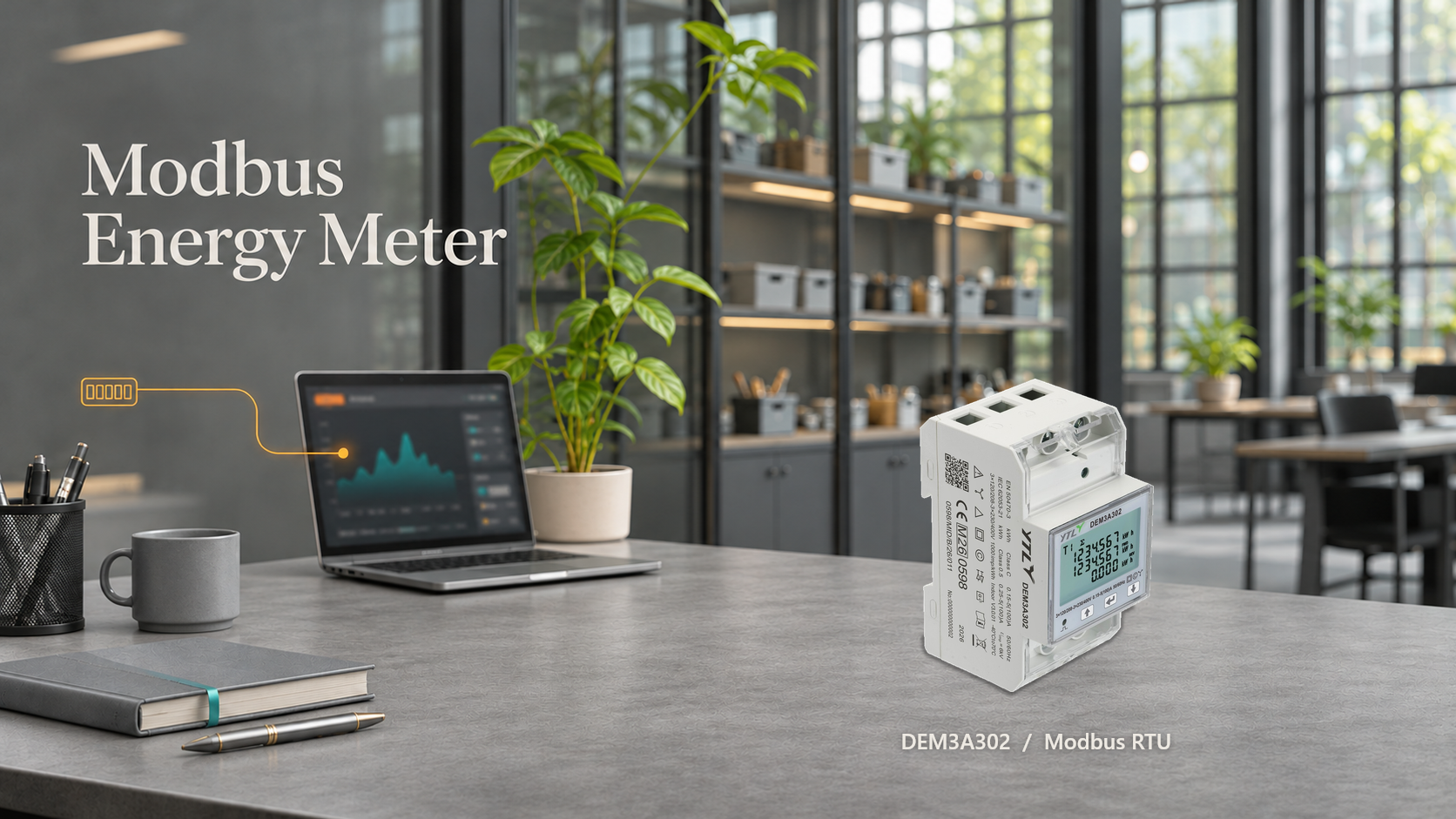
A Modbus energy meter measures electricity and lets a controller or gateway read the results. The meter records cumulative energy in kilowatt-hours (kWh) and, depending on the model, can also report active power, voltage and current to a building management system or another application.
How a Modbus Energy Meter Sends Readings
The meter takes its measurements locally and answers only when asked. The controller acts as the Modbus client and requests specific registers; the meter acts as the server and returns the values held in them.
From the Meter to the Register Map
A register is a numbered location the controller can read. The meter’s register map lists the available readings with their addresses and formats, and two Modbus meters can put the same reading at different addresses. Use the read function specified for each register type, because input and holding registers are read with different functions even when they share an address number.
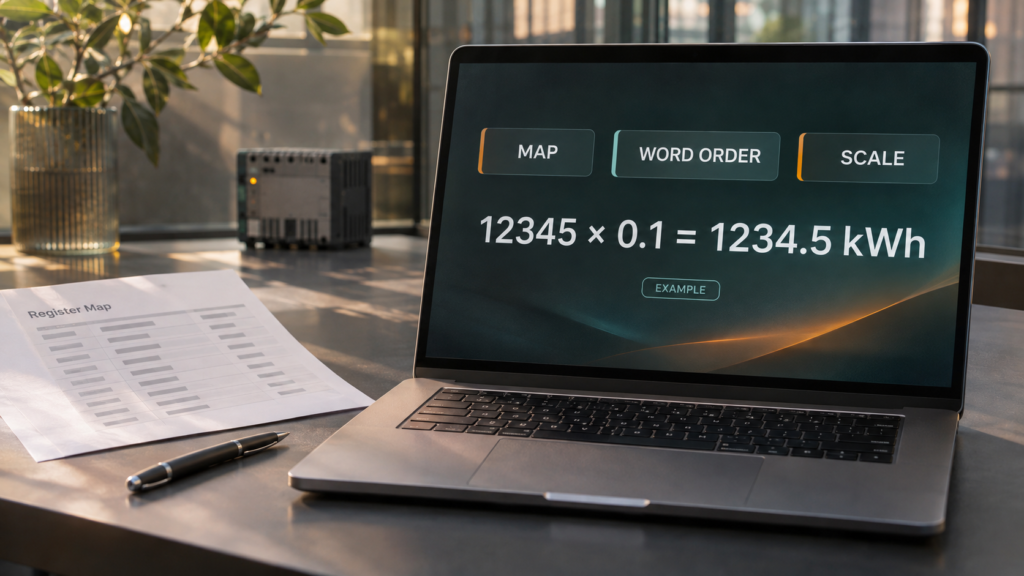
Scaling is the next trap. A meter might, for example, return a whole number that represents tenths of a kilowatt-hour, so a raw value of 12,345 means 1,234.5 kWh. If a measurement occupies two registers, the receiving system has to combine the words in the order given in the meter’s documentation before applying any scale.
Modbus RTU and Modbus TCP
Modbus RTU is a serial format commonly used over RS485. On a shared serial line, each meter needs its own address and matching baud rate and framing settings, and the controller polls one addressed meter at a time. RS485 defines only the electrical interface, so check the meter documentation for the protocol that port supports.
Modbus TCP carries Modbus messages over a TCP/IP network. A controller can read a meter with native Modbus TCP support directly over the IP network. For a meter that uses RTU over RS485, a compatible gateway translates the requests and talks to the meter on the RS485 side.

What Data Can You Read?
Use cumulative energy readings for consumption reporting and repeated power readings for load trends. The difference decides what the controller has to record.
Energy Totals in kWh
If the meter’s import register reads 1,260 kWh at 08:00 and 1,287 kWh at 18:00, the circuit imported 27 kWh during that interval, assuming the counter did not reset or roll over. On a site that exports electricity, keep import and export as separate data points when the meter provides both, since a single combined total can hide how much moved in each direction.
Meters with time-of-use metering can store a separate total for each tariff. If the reporting system also applies a tariff schedule, decide which schedule governs the report so the meter and the software do not assign consumption to different periods.
Power and Other Live Measurements
Active power in kilowatts (kW) is the rate of energy use at the moment of the reading. Current, voltage and power factor help explain what sits behind that figure. On a three-phase circuit, total active power can look steady while the per-phase current readings show one phase carrying considerably more load than the others.
A trend logged once a minute can miss short changes in load. If those peaks affect an operational decision, allow for how often the meter updates its values, how often the controller polls it and how often the software stores a reading.
From Meter Readings to a Useful Dashboard
A dashboard can go on showing 32 kW after a meter has stopped responding, simply because 32 kW was the last value it received. Show the time of the last successful read, or use a stale-data indicator, so operators can tell when to trust the number. In a consumption report, a kWh total needs the meter identity, energy direction, unit and timestamp beside it.

During commissioning, compare the value shown in the application with the same quantity on the meter display or a suitable reference. A meter can reply without errors while the application still shows the wrong value because of an incorrect register offset, word order or scale.
Where YTL DIN-Rail Modbus Meters Fit
Start with the circuit’s phase count and whether it is metered directly or through external current transformers (CTs). YTL has a DIN-rail model for each of these configurations, and all four use Modbus RTU over RS485:
| Metering point | YTL model | Measurement connection |
|---|---|---|
| Single-phase sub-circuit | DEM1E302 | Direct connection, up to 45 A, in an 18 mm module |
| Single-phase feeder | DEM2A302 | Direct connection, up to 100 A |
| Three-phase feeder | DEM3A302 | Direct connection, up to 100 A |
| Three-phase board with external CTs | DEM3K302 | External CT inputs; match the CT secondary rating to the meter input |

Where the controller reads Modbus TCP, the A119019 converter connects up to 32 RS485 devices to Ethernet or Wi-Fi. If more than one upstream system will poll through it, confirm how it queues their requests.
For repeat panel builds, check the readings on a sample with the intended controller before approving the meter. Samples are welcome for evaluation, with availability and cost confirmed case by case. Send the circuit details and the readings your controller needs, and request the wiring diagram and register map for the proposed model.
Frequently Asked Questions
Does a Modbus Energy Meter Need Internet Access?
No. A Modbus RTU meter can exchange readings with a local controller over RS485 without internet access, and Modbus TCP can also run on a local IP network. Internet access depends on how a remote platform receives the readings, for example whether a gateway has to send them to a cloud service.
Can You Recover Readings After a Communications Outage?
You can recover the total for the gap if the meter kept measuring and the same counter stayed continuous, by comparing the readings before and after it. Rebuilding individual intervals needs records from the outage itself, such as a retrievable meter profile or a gateway that kept logging while its connection to the reporting platform was down.
Does Modbus Encrypt Meter Readings?
No. Traditional Modbus RTU and Modbus TCP carry data without built-in encryption. Modbus Security is a separate specification that wraps Modbus messages in Transport Layer Security (TLS), and it only works where the equipment at both ends of the connection supports it.
Source
- MODBUS Application Protocol Specification V1.1b3, Modbus Organization: client and server roles, the register data model, vendor-specific mapping (sections 4.3 and 4.4) and register read functions.
- MODBUS over Serial Line Specification and Implementation Guide V1.02, Modbus Organization: unique device addresses on a serial line (section 2.1) and RS485 wiring.
- MODBUS Messaging on TCP/IP Implementation Guide V1.0b, Modbus Organization: Modbus TCP and gateway roles.
- MODBUS/TCP Security Protocol Specification MB-TCP-Security-v36, Modbus Organization: the separate TLS-based security specification.
