









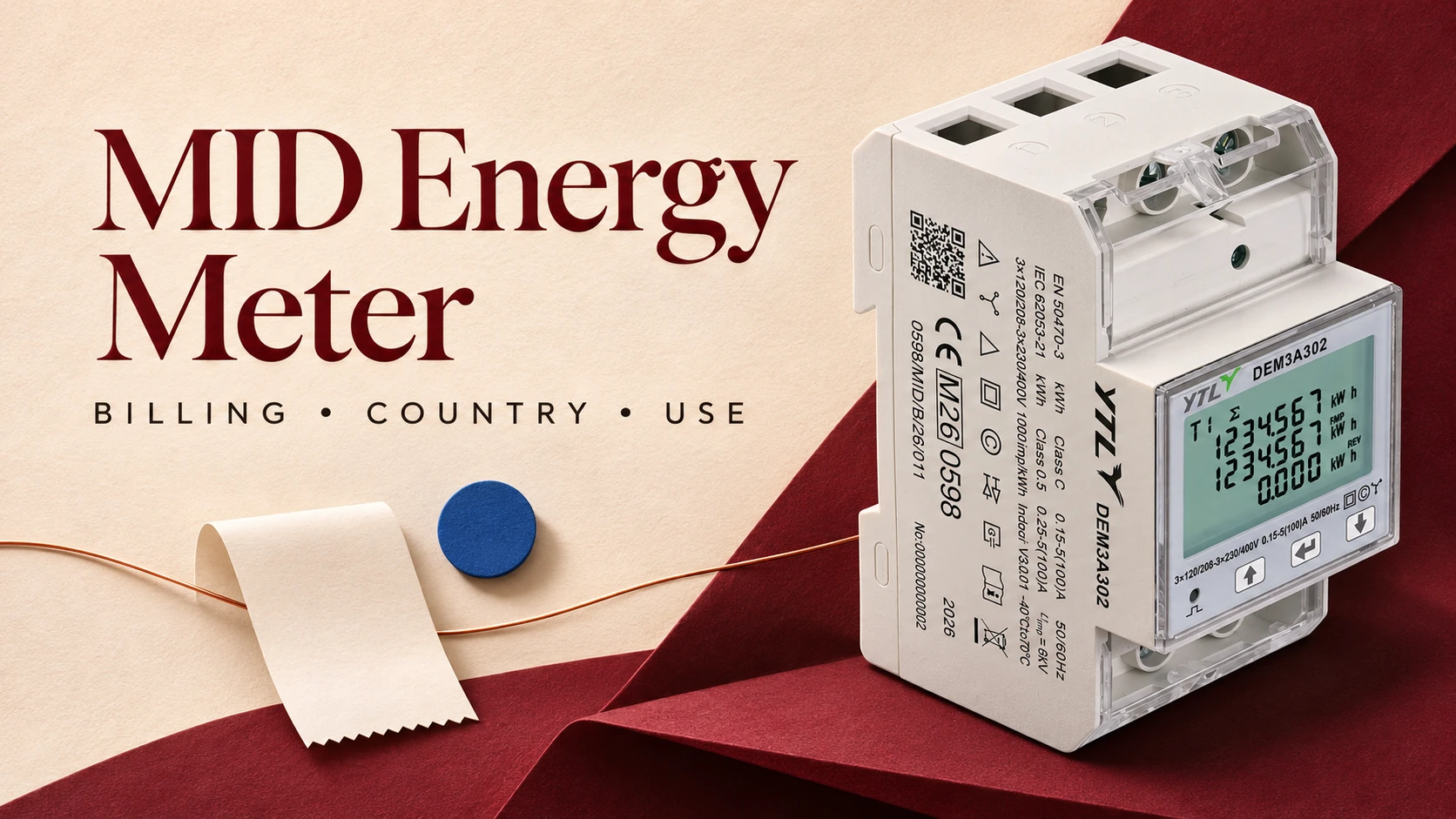
Whether a meter needs MID conformity depends on how its kWh readings are used and in which country. If the readings bill a tenant or customer, the meter must meet the legal metrology rules of the country of use. EU countries that prescribe meters for billing use the Measuring Instruments Directive (MID) for active energy meters, and both Germany and Great Britain apply their rules to landlord-to-tenant billing. A meter that only monitors your own equipment does not automatically need MID conformity.
What Is an MID Energy Meter?
An MID energy meter is an active electrical energy meter that has completed a conformity assessment route under Directive 2014/32/EU and carries the CE and M markings. Annex V of the directive sets the requirements for meters intended for residential, commercial and light-industrial use, and the manufacturer completes the route through B+D, B+F or H1. The directive does not decide which measurements must use such a meter: Article 3 leaves that to each Member State, which is why the country of use comes first in every billing project.
When Do Meter Readings Need to Meet Billing Rules?
How the reading is used is the first check, because a meter that calculates what one party pays another is reviewed differently from one that watches equipment inside a business:
| Use of the reading | Starting point for meter selection |
|---|---|
| A supplier or landlord bills a customer or tenant by kWh | Identify the approval and in-service requirements in the country of use |
| Shared electricity costs are charged to occupants | Check whether the readings behind those charges fall under local billing rules |
| A business allocates costs between its own departments | Choose a meter for internal reporting, subject to any local or contractual requirement |
| A site monitors equipment without charging anyone | Select range, accuracy and data connection; monitoring alone does not require MID |
| An operator bills drivers for EV charging by kWh | Check the charging point’s measuring system and billing data, not only the meter |
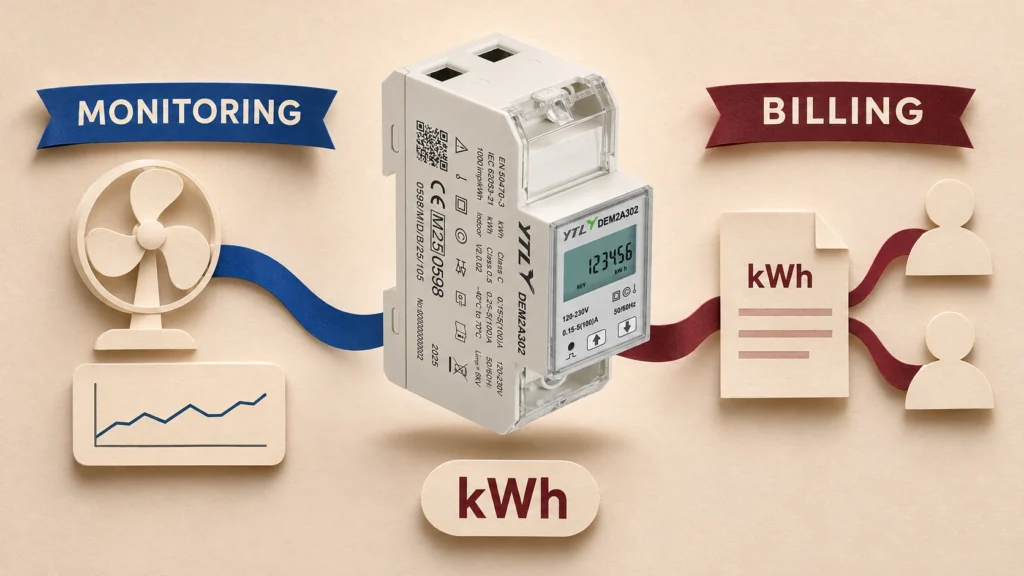
In a building with one main meter and separate electricity sub-meters for tenants, define the circuits each meter measures before you choose models. A meter that also feeds shared equipment records more than one use, so decide how that shared consumption will be split before the first bill. For each billing period, record the meter ID, register and dated start and end readings. On meters using current transformers (CTs), confirm whether the billed value already includes the CT ratio and any voltage transformer ratio.

What Do Germany and Great Britain Require?
Both countries regulate the meter’s approval when it enters service and its status for as long as it is used for billing.
Germany: Metered Tenant Charges
German verification authorities count metered billing between landlord and tenant as use in commercial transactions, so the meter must be verified. The landlord who bills is responsible, and a contract between the parties cannot waive the obligation. A meter placed on the market after conformity assessment counts as verified for its first verification period, which starts on that date. The period ends early if, for example, someone intervenes in a way that can affect the meter’s metrological properties.
German rules apply the MID’s Annex V requirements to active energy meters for household, commercial and light-industrial use. Annex 3 of the German metrology regulation accepts the same three routes: B+F, B+D or H1.
Great Britain: Approved Design and Certification
In England, Scotland and Wales, the Office for Product Safety and Standards (OPSS) requires every billing meter to be of an approved design and installed in an approved manner. The rule applies whether a licensed supplier or a landlord sends the bill. Certification can be dispensed with for secondary meters, such as landlord-tenant meters, and for non-domestic premises, but only by written agreement between supplier and consumer, and approval is still required.
Under the Measuring Instruments Regulations 2016 (MIR), certification is not a separate process: meters are approved through B+D, B+F or H1. OPSS states that a meter with Module B alone is not approved for either primary (supplier-consumer) or secondary (landlord-tenant) billing. Northern Ireland follows the EU MID under the Windsor Framework, so check it separately, as you would any other destination.
What Should You Check Before Specifying a Meter?
An approved meter still has to fit the circuit and the system that collects its readings. Before you specify a model:
- Match the exact model and configuration to its EU declaration of conformity and to the certificates for the whole conformity route.
- Specify phase, voltage, wiring and expected current, then choose between a direct-connected and a CT-operated meter.
- Identify the energy register, reading interval and receiving system for each meter.
- Confirm the interface, register map and acceptance tests with the building management or billing system integrator.

Choose a YTL DIN-Rail Meter for the Circuit
YTL’s standard DIN-rail meters for commercial and industrial sub-metering cover these circuits:

All four offer RS485 with Modbus RTU and time-of-use (TOU) metering with four tariffs. If tenants will be billed by tariff, confirm that the registers you bill from are covered by the meter’s documents. On the DEM3K302, 5(6) A means 5 A rated and 6 A maximum at the CT input, not at the feeder, so size the CT ratio to the circuit.
Each of the four meters is covered by an EU type-examination certificate under the Measuring Instruments Directive 2014/32/EU (Module B), issued by SGS Fimko Oy, Notified Body 0598. Module B covers the design only, so for tenant billing in Germany or Great Britain also ask for the declaration of conformity and the production-stage documents for your variant.
To compare the four meters for a billing project, send the destination country, who will be billed, a circuit schedule with phase and maximum current, and any CT ratios. Name the system that will read the meters as well.
FAQ
Does a DIN-Rail Meter Have to Be MID Approved?
Not necessarily. DIN rail describes how the meter is mounted; the country of use and the purpose of its readings decide which approval it needs.
Does the Meter’s Approval Cover Its Current Transformers?
Not automatically. Annex V of the MID covers electrical energy meters but not the instrument transformers used with them. For billing, check each CT’s documentation, ratio, accuracy class and any national verification requirement separately.
How Long Can an MID Meter Be Used for Billing?
It depends on the country. In Germany, an electricity meter with an electronic measuring element has an eight-year verification period. The period starts when the meter is placed on the market, presumed to be the year on its marking, and ends at the close of the calendar year in which the eight years run out. A meter marked M26 would therefore need re-verification by the end of 2034, unless a successful sampling inspection of its lot extends the period first. In Great Britain, OPSS sets no prescribed certification period for MIR-approved meters and uses in-service testing procedures instead.
Source
- Measuring & weighing instruments in the EU, European Commission: the MID and its amendments, including Directive (EU) 2026/706 for EV charging.
- Directive 2014/32/EU on the harmonisation of the laws of the Member States relating to the making available on the market of measuring instruments (recast), EUR-Lex: Article 3 on optionality, and Annex V (MI-003) scope and the exclusion of instrument transformers.
- Richtig gemessen und abgerechnet: Messgeräte für Elektrizität, Gas, Wasser oder Wärme (Stand 21.09.2022), German verification authorities (AGME): landlord-tenant billing, the landlord’s responsibility, the eight-year period and sampling extensions.
- Mess- und Eichgesetz, section 37, Federal Ministry of Justice: start and early end of the verification period for conformity-assessed meters.
- Mess- und Eichverordnung, section 8 and Annex 3, Federal Ministry of Justice: Annex V requirements and the B+F, B+D or H1 routes for EU electricity meters.
- Mess- und Eichverordnung, section 34, Federal Ministry of Justice: the year-end rule and the presumed year of placing on the market.
- National regulation: gas and electricity meters, Office for Product Safety and Standards: approval, installation and certification of billing meters in England, Scotland and Wales.
- MIR approved gas and electricity meters, Office for Product Safety and Standards: MIR routes, the billing status of Module B-only meters and in-service testing.
- Explanatory note on Directive (EU) 2026/706, Department for Business and Trade: the MID’s application in Northern Ireland under the Windsor Framework.
